
In today’s evolving VAT landscape, businesses are under pressure to keep up to date with the latest regulations, future proof processes against rule changes and maintain VAT compliance efficiency across multiple jurisdictions.
Each year, global companies are hit with costly VAT penalties and interest charges. Compliance mistakes don’t just drain money, they incur reputational damage – damaging your credibility with customers, investors and tax authorities. VAT compliance is not an option, it’s an obligation.
What’s at stake
By neglecting to implement airtight compliance, your business is exposed to:
- Costly tax office fines
- Penalties and watch listings
- Reputational damage with investors, customers and tax authorities
- Potential legal consequences
Why errors happen
Every country has unique VAT rules, deadlines and formats, making VAT compliance time-consuming and costly. For businesses operating on a global scale, these obligations mean dozens of filing obligations and registrations. Manual processes create exposure to errors, delays and missed deadlines.
Failure to comply with obligations can result in significant penalties, wasted man-hours and reputational damage.
Penalties and risks worldwide
Belgium
The Belgium tax authority imposes strict penalties for VAT compliance violations with offenders facing penalties of up to 200% of the VAT owed. In addition to percentage-based penalties, businesses may be subject to fines for late filing or failure to file of up to €5,000,000.
These penalties reflect the governments firm stance on tax evasion and fraud also seen in the eInvoicing mandate due to come into effect on 1 January 2026. Belgium B2B eInvoicing 2026: What businesses need to know
France
In France, late VAT submissions can trigger penalties of 10-80% of the VAT due. This includes:
- 10% of the VAT due where the French VAT authorities have yet to issue a formal notice
- 40% of the VAT due where late submission are more than 30 days after the first formal notice
- 80% of the VAT due where the late submission is due to secret activity
In cases of non-compliant Intrastat & ESL reporting, businesses are subject to fines of up to $1,500 per return. Every omission or inaccuracy on an Intrastat return carries a fine of €15.
Poland
The Polish tax authorities impose a fixed penalty of €1,200 for cases of late VAT submissions. Similarly, businesses with late VAT payments incur a fine of €1,200. The fine for late payments is subject to interest of between 4-12% per annum, depending on the length of the delay and whether the disclosure was voluntary.
Germany
Germany carries a surcharge of up to 10% of VAT due for instances of late filing. The surcharge is capped at €25,000 and may be accompanied by an additional enforcement fine of up to €25,000.
Cases of late, incorrect, or incomplete EC Sales Lists trigger penalties of €5,000 per violation. Where the penalty relates to a late VAT payment, interest is charged at a rate of 1% per month.
In addition, the German tax authorities may enforce personal fines on individuals responsible for a company’s late filings or payments.
Italy
In Italy, businesses who fail to submit yearly tax returns are subject to penalties of 120% of VAT due, plus up to 30% of the unpaid tax.
Late or missed VAT payments incur a standard penalty of 25% of the VAT due (reduced from 30% for violations after 1 September 2024). This is lowered if the payment is paid quickly e.g. late payments within 90 days with incur a 12.5% penalty and payments within 15 days incur a daily penalty of 0.83% of the VAT due. Interest of 5% applies for voluntary settlements, with 3.5% interest applying in cases such as tax audits.
United Kingdom
HMRC impose a penalty of between 2%-10% of VAT due for late payments or failure to file. The exact percentage penalty depends on factors such as the length of the delay, the number of previous offenses, and whether the business voluntarily disclosed the late payment or failure to file.
United Arab Emirates
The tax authorities in the United Arab Emirates (UAE) impose a fine of 1,000 AED for incorrect or late VAT filings. This penalty increases to 2,000 AED per violation for subsequent violations within a 24-month period.
For cases of late VAT payments, a penalty of 2% of VAT due is applied immediately, with a further penalty of 4% of VAT due charged monthly until the payment is made.
Singapore
In Singapore, a penalty of 5% of outstanding VAT is imposed on businesses who make late payments or fail to file a VAT return. Where the VAT payment exceeds 60 days, an additional 2% per month applies, up to a limit of 50% of the VAT due.
New Zealand
Businesses operating in New Zealand are subject to a fine of $250 per late VAT return. In addition, interest is charged at a rate of 10.88% of VAT due per annum.
Mitigate VAT compliance risks with Comply
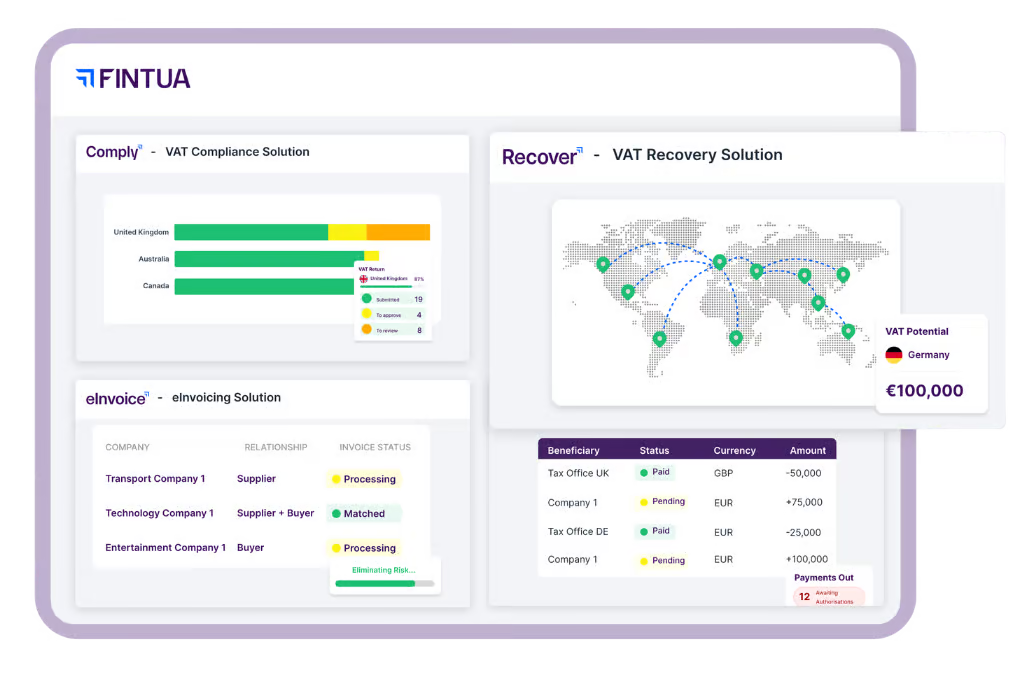
Comply automates the end-to-end VAT compliance process across 180+ jurisdictions. Updated regularly with the latest regulations, it ensures 100% compliance without manual effort.
Seamlessly integrating with leading ERP systems, Comply helps to save millions in potential penalties by boosting accuracy and efficiency across VAT processes. What once took hours of manual effort can now be completed in under 15 minutes – enabling your team to focus on higher-value, strategic work.
Subscribe to our newsletter
Stay informed about the latest VAT news, trends and topics from around the globe with our monthly newsletter. Each month, we deliver insightful updates straight to your inbox, helping you stay ahead of the curve.
Authors


Lisa Dowling
Lisa is the Chief Tax & Client Enablement Officer at Fintua and a recognised expert in international VAT compliance and digital tax transformation. With more than 24 years of VAT experience, she leads Fintua’s global tax strategy, regulatory intelligence and customer & partner enablement. Lisa is a regular speaker at international tax and finance events, sharing insights on regulatory change, digitisation and the future of global compliance. At Fintua, she helps organisations navigate regulatory change and simplify compliance in an increasingly digital tax landscape.