
For businesses operating across multiple EU countries, chain transactions are a common part of day-to-day trade. They help goods move efficiently through supply chains, but they can also create complex VAT obligations if not managed correctly.
Fortunately, the EU’s triangulation simplification rules can remove much of that administrative burden.
Understanding when triangulation applies and the conditions that must be met can help businesses avoid unnecessary VAT registrations, reduce compliance risk, and streamline cross-border transactions.
What is a chain transaction?
A chain transaction is a frequently used form of sale in international trade. It occurs when goods are sold through multiple parties but transported only once. The goods are dispatched directly from the first supplier to the last customer in the chain and there is at least 3 parties involved.
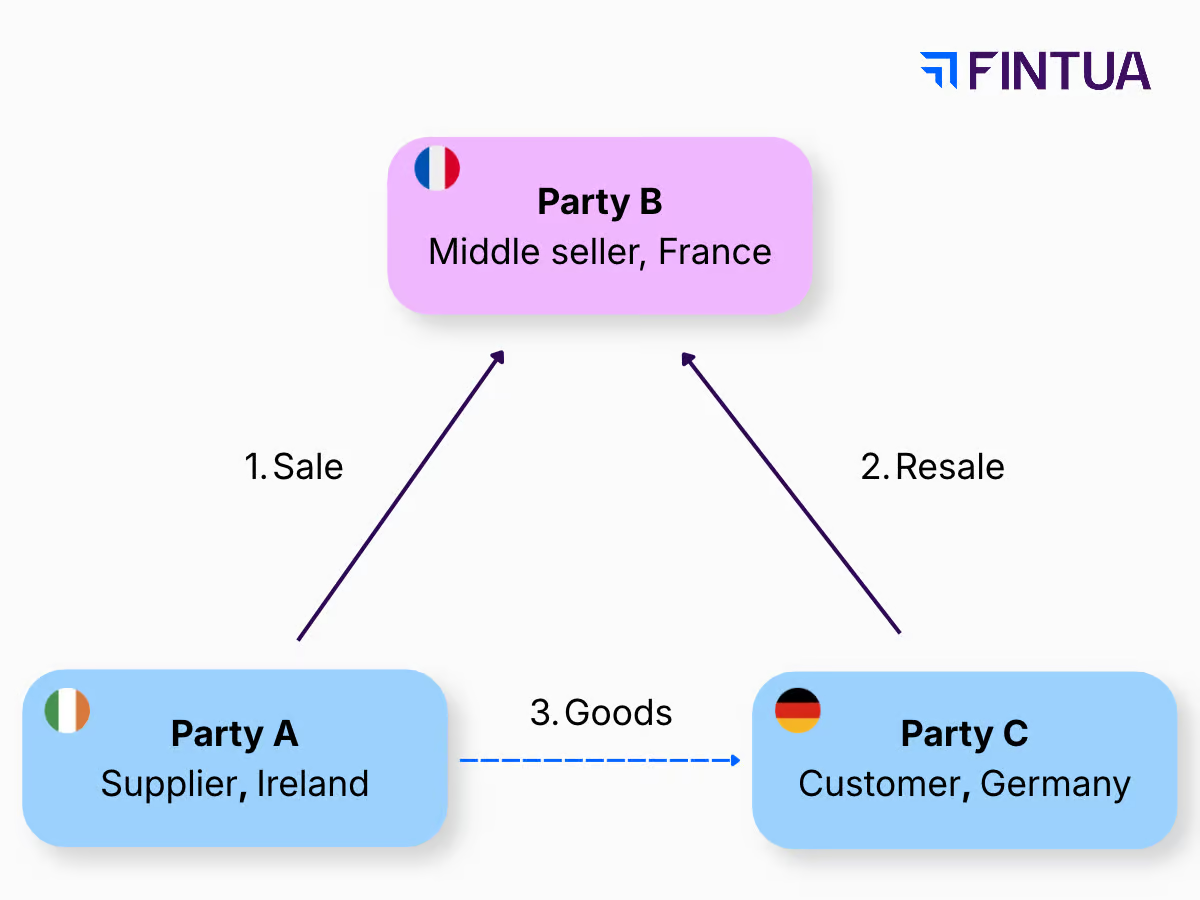
For example, a supplier in one EU Member State sells to an intermediary company, which then sells those goods to a customer in another Member State. Although the ownership changes hands several times, the goods move directly from the original supplier to the final customer.
From a tax law perspective, this creates a challenge. Only one transaction within the chain can qualify as a transport-linked (exempt) intra-Community supply, whereas the remaining transactions are generally taxed as domestic supplies. Under standard rules, this may require the intermediary businesses in the chain (entities acting as both buyer and seller) to register for VAT in the country of destination.
How VAT triangulation helps
The EU introduced triangulation simplification to reduce this compliance burden.
Where specific conditions are met, the intermediary business can avoid registering for VAT in the country where the goods arrive. Instead, the VAT liability is transferred to the final customer through the reverse charge mechanism.
In practical terms, triangulation allows the intermediary to manage the transaction using its existing VAT registration while avoiding additional reporting obligations in another Member State.
For businesses trading across borders, this can significantly simplify VAT compliance.
A closer look at the essence of simplification
Based on the VAT Directive (2006/112/EC), VAT triangulation simplification applies where three VAT-registered businesses established in three different Member States participate in a chain transaction.
The key benefit is that the intermediary business is not required to register for VAT in the destination country. The final customer accounts for the VAT due under the reverse charge mechanism, eliminating a potentially costly compliance requirement for the intermediary.
The legislation applies a legal fiction: the intra-Community acquisition by “Party B” is deemed to be taxed in the Member State of destination (Member State C), meaning “Party B” is not required to submit a VAT return or register there. “Party B” acts exclusively under the VAT number of its own Member State, and the VAT liability is shifted entirely to partner “Party C” at the end of the chain.
Strict conditions for applying triangulation
The simplification is governed by a strict and uniform EU-wide set of conditions. It can only be applied if all of the following requirements are met:
- Three different Member States: The supplier, intermediary and customer must each be VAT registered in different EU Member States.
- Direct transport: The goods must be transported directly from the first supplier to the final customer through a single cross-border movement.
- Use of VAT numbers: “Party B” must use the VAT number of its own Member State when dealing with both “Party A” and “Party C”, and must not hold a VAT registration in the destination Member State.
- Invoice content: “Party B” must issue a VAT-exempt invoice to “Party C”, which must explicitly include the “reverse charge” phrase (or its local equivalent). This is not simply an administrative requirement. Failure to include the correct wording can invalidate the simplification.
- Customer identification: “Party C” must be VAT registered in the Member State where the goods arrive.
- EC Sales List reporting: “Party B” must report the transaction correctly on its EC Sales List and identify it as a triangulation transaction.
Landmark Court Rulings: Where companies fail
Several decisions from the Court of Justice of the European Union (CJEU) demonstrate how strictly tax authorities apply these rules.
1. Invoice errors cannot be corrected retroactively
In the Luxury Trust Automobil case – C-247/2, the court confirmed that featuring the “reverse charge” statement on the invoice is not a mere formality, but a substantive requirement.
If the invoice issued by the intermediary (“Party B”) lacks this phrase, the VAT liability does not shift to the customer ” Party C”. An incorrect invoice cannot be corrected retroactively: a subsequently issued correct invoice only produces legal effects from the date it is received by the customer. Consequently, the intermediary company may face legal consequences in its own Member State due to the interim period.
For businesses, this highlights the importance of robust invoicing controls and accurate VAT determination processes.
2. Does “Party C” have to be the physical final destination?
Recent case law, e.g. MS KLJUČAROVCI Case T-646/24, indicates that simplification does not strictly require the goods to stop at the destination country. If the customer, “Party C” immediately resells the goods to a subsequent party within the same destination country before the goods physically arrive, this does not automatically rule out triangulation simplification, provided all other conditions are fully met.Recent case law, e.g. MS KLJUČAROVCI Case T-646/24, indicates that simplification does not strictly require the goods to stop at the destination country. If the customer, “Party C” immediately resells the goods to a subsequent party within the same destination country before the goods physically arrive, this does not automatically rule out triangulation simplification, provided all other conditions are fully met.
However, businesses must still satisfy all other triangulation requirements and ensure they are not participating in arrangements connected with VAT fraud.
Rules are not identical everywhere
Although triangulation is based on harmonised EU rules, there are significant deviations in national legislation and local tax authority practices that require close attention when dealing with foreign partners:
- Netherlands (NL): The Dutch approach is among the strictest. Dutch law requires the final customer to be established in the Member State of destination – simply holding Dutch VAT number is insufficient.
- Germany and Austria (DE, AT): Both tax authorities apply the court rulings. If the required reverse charge note is missing from the invoice, the authorities deny the simplification and assess retroactive VAT liabilities against the intermediary trader.
The majority of Member States (e.g. Italy, Spain, Hungary, Poland, Romania) the rules largely mirror the VAT Directive. Differences in these countries mostly relate to reporting requirements and invoice wording rather than the core conditions for applying the simplification.
Key takeaway
Triangulation can deliver significant VAT compliance benefits for businesses involved in EU cross-border supply chains. However, the simplification only works when every condition is met and the transaction is reported correctly.
Something as simple as incorrect invoice wording, the wrong VAT number, or a misunderstanding of local requirements can quickly turn a simplified transaction into a costly foreign VAT registration loop.
Trading across multiple EU countries? Fintua’s VAT experts can help you assess whether triangulation applies, identify potential compliance risks, and simplify your cross-border VAT obligations.
Authors


Péter Árpás
Péter is a Tax Lawyer and a Certified International Tax Expert with over 15 years of experience in VAT advisory and compliance. Combining a solid Big4 background with valuable experience working with tax authorities, he has been with Fintua for the past 6 years, advising high-profile international clients. His practice focuses on managing tax inspections and solving complex global VAT problems for multinational businesses.