
Growth creates opportunity, but it also creates complexity. As businesses grow through acquisitions, international expansion and new operating models, what was once a single legal entity can quickly evolve into a network of subsidiaries, regional offices and shared service centres operating across multiple jurisdictions.
For tax and finance teams, this creates a challenge: how do you manage VAT efficiently across dozens of entities while maintaining compliance and control?
One solution available in many countries is VAT grouping.
Available in many jurisdictions, VAT groups can reduce administration, simplify reporting and streamline the VAT treatment of transactions between related entities. However, the rules differ considerably between countries, making VAT groups challenging for multinational organisations to manage.
What is a VAT group?
A VAT group allows two or more legally separate entities to be treated as a single taxable person for VAT purposes. Although each company remains a separate legal entity, the tax authority views the group as one VAT taxpayer.
The eligibility criteria vary by country, but VAT grouping is generally available where the entities are closely connected through ownership, management and business activities. Many jurisdictions assess whether members share financial, economic and organisational links before allowing a VAT group to be formed. In Ireland, for example, Revenue assesses these connections when determining whether entities can enter a VAT group.
The aim of a VAT group is to reduce unnecessary VAT administration between entities that already operate as part of the same business group.
What are the benefits of using VAT groups?
For large enterprises operating through multiple entities, VAT groups offer significant administrative and operational advantages.
- Fewer VAT returns: Without a VAT group, each legal entity may need to prepare and submit its own VAT return. For multinational organisations with dozens of entities, this could mean preparing dozens of separate returns for the same reporting period. Where the local regime allows a consolidated return, a VAT group can reduce this to a single filing. This can significantly reduce the administrative work required from tax, finance and compliance teams. The precise filing requirements depend on the country. Some jurisdictions accept one consolidated return, while others require a combination of group-level and entity-level filings.
- Simplified intercompany transactions: Another major benefit relates to transactions between members of the VAT group. In many VAT group regimes, supplies between group members are disregarded for VAT purposes. This means some transactions between group members can be ignored for VAT purposes, reducing invoicing and reporting requirements. For businesses with complex internal supply chains, shared services functions or centralised operating models, this can remove a considerable amount of administrative complexity.
Which businesses benefit the most from VAT groups?
While VAT groups can be beneficial for organisations of all sizes, they often deliver the greatest value for businesses that operate through multiple entities.
Examples include:
- Multinational corporations with regional subsidiaries
- Shared service centre models
- Retail and consumer goods groups
- Manufacturing businesses with complex supply chains
- Financial services organisations
- Private equity portfolios with interconnected trading entities
- Groups that have grown through acquisition
These organisations frequently transfer services, costs and resources between entities. Without VAT grouping, the resulting compliance obligations can become highly fragmented.
VAT group rules vary by country
The concept of a VAT group is similar across countries, but the rules around eligibility requirements and filing obligations vary significantly from one jurisdiction to another. For example:
- Some countries allow a single consolidated VAT return for the entire group
- Some require both consolidated and individual entity-level filings
- Some permit only individual filings within the group structure
- Some jurisdictions like Bulgaria, Lithuania and Portugal don’t permit VAT groups at all
- In Portugal, since 1 July 2026, a newly introduced VAT system serves account consolidation purposes rather than functioning as a standard Directive-like VAT group
- Countries apply different rules to branches, head offices and other establishments located outside their territory
Multinational businesses can’t assume that a VAT grouping structure established in one country can simply be replicated elsewhere.
Territorial scope of VAT groups
Territorial scope is particularly important for multinational businesses as they vary from country to country. For example, Ireland has recently made changes and has aligned more closely with EU case law and generally limits Irish VAT groups to Irish establishments only with foreign establishments excluded. This means that non-Irish head offices or company branches cannot be a member of an Irish VAT group, which also means that supplies between these non-Irish establishments are now within the scope of VAT.
The Netherlands also changed its VAT grouping rules from 1 January 2024 so that foreign head offices and foreign fixed establishments can no longer be a part of a Dutch VAT group.
Managing VAT groups with Fintua Comply
Managing a VAT group can be complex. Many multinational organisations operate multiple ERP systems, different accounts structures and separate finance processes across their entities. Even when a consolidated VAT return is available, tax teams still need access to accurate underlying data and visibility into the calculations behind the final filing.
Managing multiple countries, entities and systems require the right processes and technology. Purpose-built tax technology helps organisations centralise VAT group management, automate data collection, consolidate reporting and maintain a clear audit trail from entity-level transactions to the final submission.
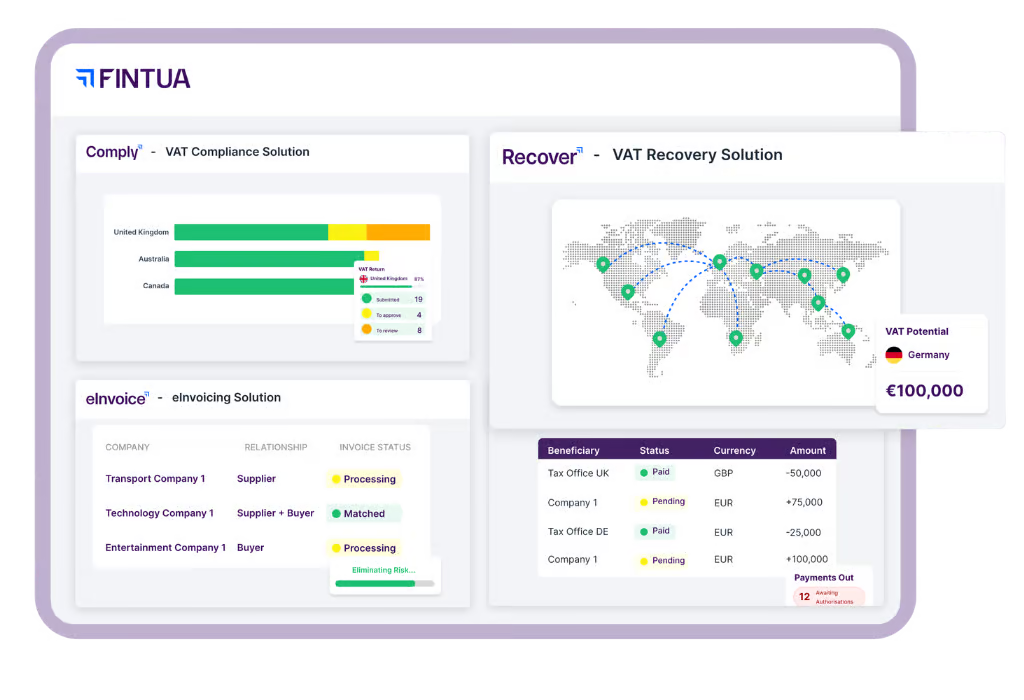
With Fintua Comply, organisations can manage VAT groups across jurisdictions, support country-specific filing requirements and consolidate data from multiple ERP systems within a single platform. Whether preparing entity-level calculations, or managing groups spanning dozens of entities, Comply provides the visibility and control needed to scale compliance with confidence.

Final thoughts
VAT grouping can be an effective way to simplify VAT compliance and reduce administrative burden. However, success depends on understanding local requirements and maintaining control over increasingly complex data landscapes.
As VAT rules continue to evolve, organisations that combine strong governance with scalable tax technology will be best positioned to simplify compliance, reduce risk and operate with confidence.
Authors


Helen Long
As Fintua’s Content Marketing Manager, Helen creates content that helps tax and finance professionals stay informed of the ever-changing world of VAT.