
For a long time, VAT compliance was built around periodic reporting, retrospective audits and manual reviews. Tax authorities relied on VAT returns, supporting documentation and human investigation to identify errors, assess risk and detect non-compliance. However, this model is rapidly disappearing and VAT returns alone are no longer trusted as the single source of truth.
Around the world, tax authorities are investing heavily in artificial intelligence (AI), real-time reporting infrastructures and advanced analytics capabilities. Their objective is to move from reviewing compliance after the fact to monitoring it as transactions occur.
The result is a shift in the relationship between businesses and tax administrations. Tax authorities are no longer simply collecting tax. Increasingly, they are governing through data.
A new era of continuous compliance
The expansion of eInvoicing and digital reporting mandates has given tax authorities unprecedented visibility into business activity. In many jurisdictions, invoice-level transaction data is now being reported directly to government platforms in near real time.
What makes this transformation particularly significant is the role of AI.
With access to vast volumes of structured transactional data, tax authorities can use AI and machine learning to identify anomalies, detect patterns, monitor trends and target compliance risks more effectively than ever before. Rather than relying on audits or reactive investigations, authorities can focus their attention where data suggests potential issues exist.
For businesses, this means compliance is becoming a continuous process rather than a periodic exercise.
AI-powered risk detection
AI is enabling tax authorities to analyse taxpayer data at a scale and speed that would have been impossible a few years ago.
How AI identifies compliance risks
With access to detailed, structured and increasingly real-time transactional data, AI systems can:
- Identify anomalies between invoices, VAT returns and financial reports
- Detect duplicate, missing or potentially fraudulent transactions
- Highlight unusual trading patterns
- Identify businesses operating outside expected industry norms
- Prioritise high-risk taxpayers for further review.
In many cases, AI allows tax authorities to move beyond retrospective audits towards predictive compliance models. Potential issues can be identified and investigated before formal audits begin, allowing authorities to deploy resources more efficiently and focus on the areas of greatest risk.
Fighting tax fraud at scale
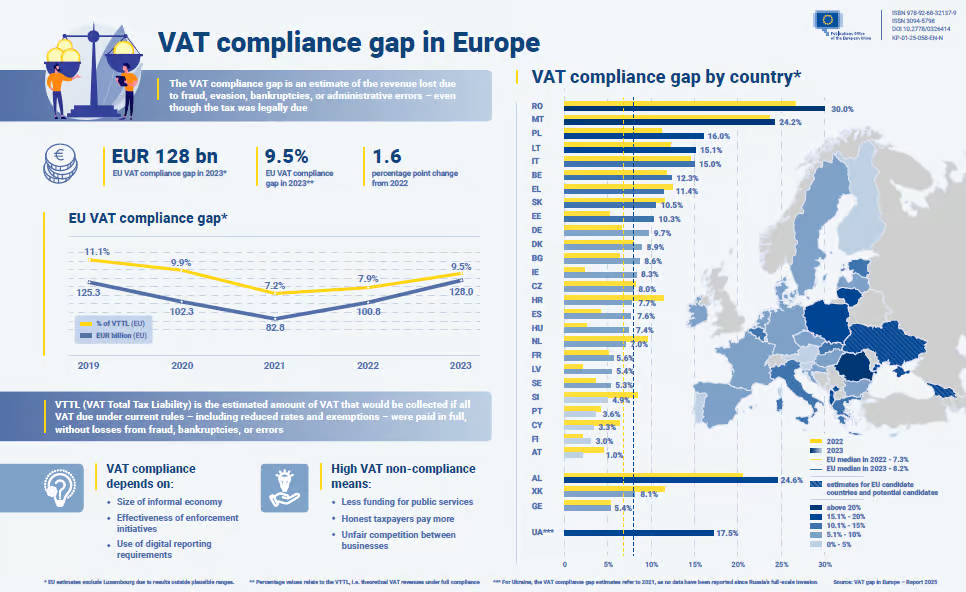
Tax fraud detection remains one of the primary drivers behind government investment in AI. The EU VAT gap, which measures the difference between the VAT revenue expected and the amount actually received, reached €128 billion in 2023, an increase of €27 billion compares with 2022 (European Commission). The scale of this revenue loss highlights why tax authorities are investing heavily in advanced analytics and AI-powered monitoring capabilities.
Complex VAT fraud schemes often involve thousands of transactions spread across multiple entities and jurisdictions. Analysing these networks manually is both time-consuming and resource-intensive.
AI is changing that. By analysing large volumes of transactional data in real time, tax authorities can identify connections between seemingly unrelated transactions, invoices and reporting patterns. This enables them to detect suspicious activity more quickly, uncover fraud networks earlier and intervene before significant tax losses occur.
As fraud schemes become more sophisticated, tax authorities are increasingly relying on AI to strengthen enforcement efforts and close the VAT Gap more effectively.
What businesses need to learn from AI-driven tax authorities
Many organisations still view tax compliance through the lens of returns and filings. However, in an AI-enabled regulatory environment, the quality of the underlying data becomes just as important as the final submission.
Incomplete master data, inconsistent tax codes, reconciliation gaps and fragmented systems may have gone unnoticed in a traditional reporting environment. Today, those same issues can be identified almost immediately when tax authorities compare datasets, identify exceptions or apply automated validation rules.
Can your data withstand real-time scrutiny?
As tax authorities become more sophisticated, businesses must ask themselves an important question: Does our data stand up to real-time scrutiny? If you’re unsure about the answer, now is the time to act.
Improving the taxpayer experience
While much of the discussion around AI focuses on enforcement, tax authorities are also using AI to improve taxpayer services.
Many administrations are deploying AI-powered virtual assistants, automated support tools and intelligent case management systems to provide faster responses to taxpayer queries and improve service delivery.
Examples from France, Spain and Greece
For example, France’s tax administration (DGFiP) is using AI to analyse incoming taxpayer correspondence and generate draft responses for officials to review before sending. AI-powered taxpayer assistance is also being adopted elsewhere. The Spanish Tax Agency (AEAT) uses AI-driven virtual assistants to help taxpayers navigate filing obligations, deadlines and VAT requirements, while Greece’s Independent Authority for Public Revenue (AADE) has introduced an AI-powered assistant that provides real-time support for common taxpayer queries. (Forbes.com)
These technologies can help reduce administrative burdens while allowing tax officials to focus on more complex cases. The long-term objective is not simply greater enforcement, but more efficient and effective tax administration.
Technology alone is not the answer
There is a lot of discussion about AI within the tax industry, but technology itself is only part of the solution.
The most successful tax functions will be those that combine intelligent technologies with strong governance, robust processes and experienced human oversight. AI can accelerate analysis, surface exceptions and improve visibility, but businesses still need tax expertise to interpret results, assess risk and make informed decisions.
This is why we believe the future is not AI-powered compliance. It is intelligence-powered compliance.
The combination of technology, data and human expertise creates a far more resilient compliance model than any one element alone.
Why reconciliation is becoming critical
One of the most important developments emerging from real-time reporting environments and AI-enabled tax administrations is the growing need for reconciliation.
As eInvoicing data flows directly to tax authorities, organisations need confidence that the information reported through government platforms aligns with VAT returns, ERP data and financial records. Increasingly, tax authorities are using automated data-matching techniques to compare information reported across multiple sources and identify inconsistencies.
How tax authorities are cross-checking data sources
A recent example comes from Italy. In June 2026, the Italian Revenue Agency launched a nationwide compliance campaign to identify inconsistencies in 2025 annual VAT returns. The initiative involved cross-checking VAT return against from eInvoice records and electronic daily receipt data already held by the tax authority.
This campaign highlights a broader trend. Tax authorities are no longer relying solely on information submitted through VAT returns. Instead, they are increasingly comparing multiple datasets, applying automated controls and using advanced analytics to identify anomalies that warrant further investigation.
As AI capabilities continue to evolve, these processes are likely to become faster, more sophisticated and more proactive.
Discrepancies will inevitably occur. The difference is that tax authorities now have greater visibility into those discrepancies and increasingly sophisticated tools to identify them. Businesses that can explain differences quickly and confidently will be in a far stronger position than those trying to investigate issues after a query has been raised.
Increasingly, reconciliation is becoming a core component of modern tax governance rather than simply a compliance control or post-filing activity.
Want to learn more? Watch our latest webinar on VAT reconciliation and discover how organisations can build greater confidence in their data before tax authorities identify discrepancies for them.
Preparing for the future of AI-driven VAT compliance
It’s clear to see where we are headed. Tax authorities will continue investing in AI, advanced analytics and real-time compliance monitoring. Digital reporting obligations will expand. Expectations around data quality and transparency will continue to increase.
For tax leaders, the challenge is no longer preparing for a future digital environment. That future has already arrived.
Key actions for tax leaders
The organisations that succeed will be those that
- Improve data quality
- Strengthen reconciliation
- Modernise fragmented processes
- Embrace intelligent automation
- Adopt a connected approach to compliance across jurisdictions.
In a world where tax authorities are governing with AI, businesses need more than reactive compliance. They need visibility, confidence and the ability to respond to regulatory change in real time.
Because the question is no longer whether tax administrations will use AI to monitor compliance.
It’s how prepared your organisation is when they do.
Join the Fintua community
Stay informed about the latest VAT news, trends and topics from around the globe with our monthly newsletter. Each month, we deliver insightful updates straight to your inbox, helping you stay ahead of the curve.
Authors


Helen Long
As Fintua’s Content Marketing Manager, Helen creates content that helps tax and finance professionals stay informed of the ever-changing world of VAT.