
For most tax teams, VAT compliance is measured against one key milestone – successfully submitting the VAT return on time.
Tax teams invest significant time gathering transaction data, validating VAT treatments, reconciling balances, resolving exceptions, securing approvals and meeting filing deadlines. Over the last decade, businesses have transformed many of these processes through automation, centralisation and digital compliance platforms.
Paying the VAT liability is the one part of the VAT compliance journey that often remains disconnected from the rest of the process. Because VAT compliance does not end when the return is filed, it ends when the correct payment is delivered to the tax authority on time.
Why VAT payments are the overlooked final step in VAT compliance
Businesses have invested significantly in improving the preparation, review and submission of VAT returns and digitising their operations with eInvoicing. But the payment that follows a VAT return is frequently treated as a separate treasury or accounts payable process.
Where the return shows a VAT payable position, it creates another regulatory obligation. The business must ensure that the correct amount is paid to the correct tax authority, using the correct payment reference and before the applicable deadline.
What makes this challenging is that different teams often own different parts of the process.
- The tax team prepares and validates the return
- Treasury manages cash positions
- Finance or Accounts Payable executes the payment
- Banking systems handle the settlement
- Tax authorities receive and allocate the funds
At this point, what was previously a structured compliance workflow can become a series of manual handoffs. For an organisation managing obligations across multiple entities and jurisdictions, repeating this process every filing period creates significant operational complexity.
The return may have been prepared in a controlled compliance environment, but the payment process can quickly move into emails, spreadsheets, banking portals and manual approvals.
This creates a disconnect between what was reported and what was ultimately paid.
A correct VAT return doesn’t guarantee compliance
One of the most important realities for VAT teams is that a return can be calculated correctly, reviewed and approved, submitted on time and still create compliance issues if the payment process breaks down.
How does the payment process break down? Payment references may be entered incorrectly, beneficiary details may be outdated, payment approvals may be delayed, cross-border transfers may not settle when expected or finance teams may be operating to a different timeline than the tax team.
From the tax authority’s perspective, the liability remains outstanding until the payment is received and allocated correctly.
This is why tax professionals increasingly need visibility not just into VAT reporting, but into what happens after submission.
The visibility problem
One of the biggest risks isn’t necessarily payment failure, it’s the lack of visibility.
Tax teams often know:
- What is due
- When it’s due
- Which return generated the liability
But, once the return is submitted many tax teams lose sight of what happens next:
- Whether the payment has been approved
- Whether funds have been released
- Whether settlement is in progress
- Whether the tax authority has received the payment
- Whether the liability has been correctly allocated
That uncertainty creates additional work, particularly around month-end close, audits and tax authority queries. It also forces tax professionals to spend time chasing updates across finance, treasury and banking teams.
Why cross-border tax authority payments are so complex
1. Multiple jurisdictions
VAT payments may seem relatively straightforward, but for businesses operating across multiple jurisdictions, the picture looks very different. Every jurisdiction may introduce unique requirements around:
- Payment deadlines
- Payment references
- Beneficiary information
- Banking arrangements
- Currency requirements
- Payment deadlines
- Local payment methods
Many groups are also managing dozens, or even hundreds, of VAT registrations across multiple regions. So what begins as a simple tax payment quickly becomes a complex operational exercise involving multiple teams, systems and banking networks.
2. Multiple currencies
Many businesses need to fund VAT liabilities in currencies different from the currency held in their bank accounts.
This introduces foreign exchange considerations, including:
- Exchange rate exposure
- Transfer costs
- Payment timing
- Transparency of fees
- Certainty over the final amount received
Without proper visibility, businesses can struggle to forecast and manage the true cost of international tax payments.
3. Multiple banking networks
Traditional international payments frequently rely on correspondent banking networks and SWIFT messaging. While these systems remain widely used, they can create additional complexity around tracking, settlement visibility and payment timing.
For VAT payments tied to statutory deadlines, certainty matters. Tax teams need confidence that payments have not simply been instructed, but have progressed through the payment chain as expected.
The hidden cost of a disconnected compliance process
A fragmented payment process doesn’t just create administrative inconvenience. It can expose the business to both compliance and operational risk.
Compliance risks
Depending on the jurisdiction and circumstances, late, incorrect or unallocated payments can lead to:
- Late payment interest
- Regulatory penalties
- Outstanding balances with the tax authority
- Increased audit scrutiny
- Additional correspondence and investigations
- A weaker compliance record
For example, Ireland’s Revenue Commissioners state that interest on late VAT payments is charged daily from the payment due date until the outstanding amount is paid. The published rate is 0.0274% per day or part of a day. Poland also imposes a penalty of a €1,200 fine for late VAT payments with interest of 4-12% per year added, depending on the length of delay and whether the disclose was voluntary. In Italy, late VAT payments incur a standard penalty of 25% of the unpaid VAT.
The financial consequences can build quickly where the underlying liability is significant. Penalties and interest also vary considerably between jurisdictions, making it important to check the applicable local rules. You can explore further examples in VAT compliance: costs, risks and penalties.
Operational risks
Disconnected payment processes can also create:
- Manual reconciliation work
- Time spent chasing payment updates
- Delays during month-end close
- Difficulty producing audit evidence
- Uncertainty over cash positions
- Duplicate or incorrect payments
- Inconsistent approval controls
- Cash flow inefficiencies
- Reduced confidence in compliance controls
These risks become harder to manage as an organisation grows internationally. A process that works for five VAT registrations may become unsustainable across 50 or 100.
The larger the compliance footprint, the more important it becomes to have a consistent and repeatable VAT payment process with clear ownership, visibility and control.
What should a modern VAT payment process look like?
VAT payments shouldn’t be treated as a separate treasury activity, leading organisations are starting to view them as a continuation of the compliance process itself. A modern VAT payment process should be accurate, timely, secure, visible and connected.
Accurate: Payment information should be linked directly to the approved VAT liability. This reduces the need to re-enter amounts, currencies, beneficiary details and payment references in separate systems.
Timely: Teams should be able to manage payments against the relevant tax authority deadlines, with clear visibility over upcoming obligations and outstanding actions.
Secure: Payment processes should include appropriate controls and approvals while reducing unnecessary handling of sensitive financial information.
Global: The process should accommodate multiple jurisdictions, currencies, entities, bank accounts and local payment requirements without creating a different manual workaround for every market.
Visible: Tax, finance and treasury teams should be able to see what is due, what has been approved, what has been paid and what remains outstanding.
Connected: Payment should form part of the wider VAT compliance process, rather than becoming a separate final task managed outside the original workflow.
Bringing VAT filing and payment together
Connecting VAT filing and payment closes the operational gap between reporting a liability and settling it.
Instead of manually transferring approved liability data into a separate banking process, the VAT return can become the starting point for the payment workflow.
The amount, currency, beneficiary, payment reference and deadline can remain connected to the underlying obligation through review, approval and execution.
This creates a more complete compliance workflow:
1.The VAT data is collected and validated
2. The return is prepared and reviewed
3. The VAT liability is approved
4. The return is submitted
5. The resulting payment is initiated
6. The payment moves through the appropriate approvals
7. Its status is tracked through the payment process
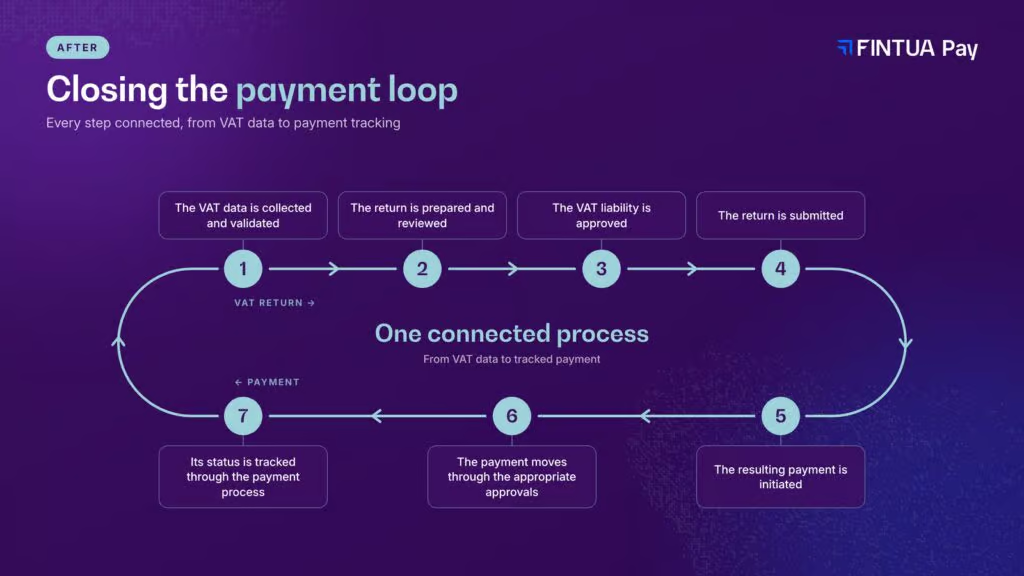
This reduces the number of manual handovers between teams and systems. It also gives tax, finance and treasury a shared view of the liability and its payment status.
Rather than gathering evidence from emails, spreadsheets, banking portals and tax systems, organisations can maintain a connected record from return preparation through to payment.
Closing the payment loop with Fintua Pay
Fintua Pay enables organisations to execute tax authority payments as part of a connected VAT compliance process.
Embedded within Fintua Comply, it allows businesses to move from preparing and filing a VAT return to paying the resulting liability through a connected workflow. This helps close the operational gap between reporting an obligation and ensuring it is settled.
The objective isn’t to turn tax teams into payment operators. Treasury and finance teams still maintain their roles, controls and approval responsibilities.
Instead, Fintua Pay helps ensure that everyone is working from the same liability information, with greater visibility into payment status, approvals and execution.
The result is a more connected compliance journey:
Prepare the return. Submit the return. Pay the liability. Track the outcome.
All within a single workflow.
Compliance doesn’t stop at submission
As tax reporting becomes increasingly digital, the payment processes cannot remain fragmented and manual.
Tax teams need to know more than what’s due. They need confidence that the correct amount will reach the right tax authority, with the right information and by the required deadline.
Connecting tax authority payments to the wider VAT compliance workflow can reduce manual administration, improve visibility, strengthen reconciliation and create a clearer audit trail.
Because filing the return creates the obligation.
Payment closes it.
Complete the VAT compliance journey
Submitting the VAT return is only part of the compliance process. The liability still needs to be paid accurately, securely and on time.
Watch our latest webinar, Complete the VAT Compliance Journey: Close the Payment Loop, where our experts explore the challenges of managing VAT payments across jurisdictions, the risks of disconnected processes, and what a more connected approach to compliance and payments looks like.