
When businesses think about eInvoicing, the focus is usually on compliance, reporting and accounts payable automation.
But there’s a quieter, often overlooked impact – one that sits outside traditional AP processes and directly affects cash flow:
VAT recovery on travel and entertainment (T&E) expenses.
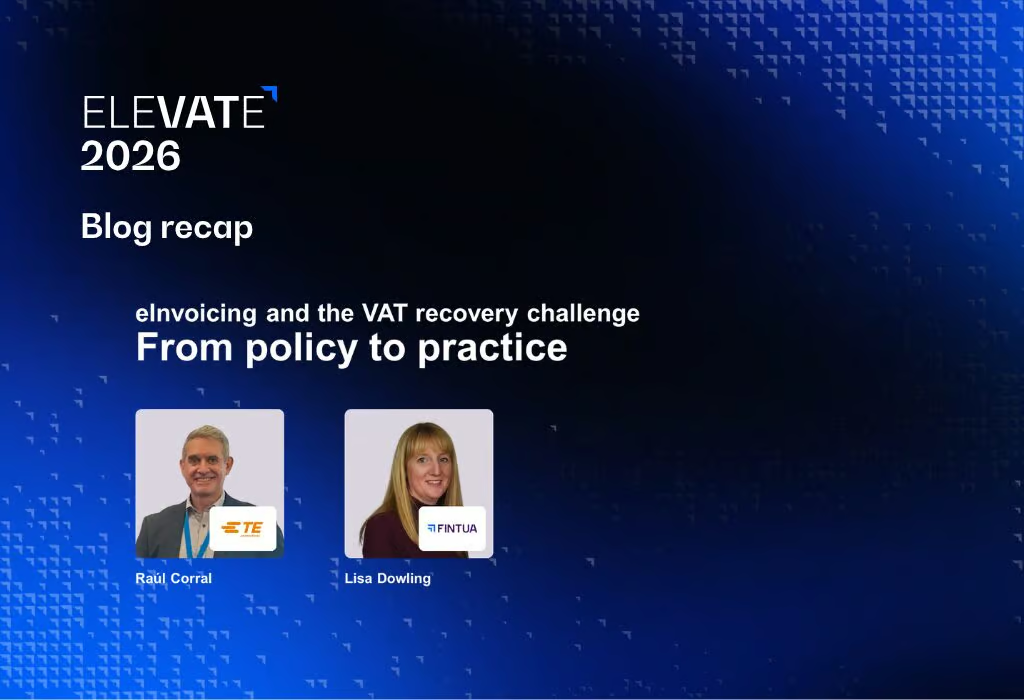
At Fintua’s ELEVATE event, Lisa Dowling (Chief Tax & Compliance Officer) and Raul Corral (Indirect Tax Senior Manager, EMEIA at TE Connectivity) explored how eInvoicing is fundamentally changing how businesses capture, process and recover VAT on employee expenses.
What emerged is clear. T&E VAT recovery is becoming more complex, more technical and more critical to get right.

The “old” world: Manual, fragmented, but familiar
Historically, T&E VAT recovery followed a process that, while manual, was relatively well understood.
Employees would:
- Request invoices at point of purchase (e.g. hotels)
- Receive PDFs or paper receipts
- Upload them into expense management systems, like Concur
- Trigger downstream VAT recovery processes
From there, solutions like Fintua would:
- Assess invoice compliance (full vs simplified invoices)
- Apply country-specific deductibility rules
- Compile domestic VAT recovery reports
As Raul explained:
“You go to the reception, you ask for the invoice…then normally you get the invoices scanned or you put it into your travel system. From there, the magic starts.”
The process worked, but it relied on manual effort and employee awareness – something eInvoicing is now changing.
Enter eInvoicing: The process breaks
eInvoicing disrupts this model at its core. Instead of invoices going to employees, they now:
- Flow directly to central systems (via Peppol or local platforms)
- Arrive as structured XML data, not human-readable PDFs
- Bypass the employee entirely
This creates a fundamental challenge:
How do you identify and process T&E expenses when they no longer sit within the employee expense flow?
From PDF to XML: A data problem, not a document problem
As Raul explains, the shift to XML introduces a new layer of complexity:
- No visual invoice (logos, layouts, familiar formats disappear)
- Data must be interpreted, not read
- Fields must be correctly populated at source
And critically, T&E invoices must now be identified within large volumes of incoming structured data. This is where many businesses hit their first roadblock.
The duplicate payment risk in eInvoicing
One of the most immediate risks in an eInvoicing world is duplication.
Without clear separation:
- T&E invoices can enter the accounts payable (AP) workflow
- While the same expense is also submitted via expense management tools
The result? Duplicate payments and reconciliation headaches. To mitigate this, businesses must introduce intelligent filtering mechanisms.
The new requirement: Classification logic
TE Connectivity’s approach highlights what’s now required. To isolate T&E invoices, businesses need to:
- Use payment method indicators (e.g. corporate credit card)
- Leverage employee identifiers (e.g. email addresses)
- Define custom rules within XML schemas
This is no longer a finance-only task.
It requires collaboration between:
- IT
- Tax
- AP
- Expense management teams
And it introduces a new reality. A manual step at the start is required to enable automation at scale.
Reconciliation is harder, not easier
eInvoicing doesn’t remove reconciliation, it intensifies it. Businesses must now match:
- Incoming eInvoices (XML)
- Expense system data (e.g. Concur)
- Payment data
All while managing:
- Timing differences
- Data inconsistencies
- Missing or misclassified fields
And in many countries, VAT recovery is now dependent on having the correct eInvoice, not just any invoice.
The cost of doing nothing: A direct P&L impact
Some businesses have already opted out of solving this challenge. In early eInvoicing markets like Italy and Romania, many chose to treat T&E as B2C or simply skip VAT recovery altogether.
The result was lost VAT, which is a direct hit to the P&L (profit and loss)
As Raul highlights, this approach isn’t sustainable, especially in high-recovery markets like Germany.
Not all countries are equal
One of the biggest complexities is fragmentation across jurisdictions. For example:
- Belgium: Low recovery potential, high administrative burden
- Poland: Highly formalised requirements, even for “simplified” invoices
- Germany: Significant VAT recovery opportunity
“Input VAT deduction is always a bit forgotten about…but it adds to the cash flow of the business,” said Lisa.
This creates a strategic challenge. Where do you invest in solving T&E VAT recovery and where do you deprioritise?
The end of simplified invoices?
eInvoicing may also signal the beginning of the end for simplified invoices. While EU VAT Directive provisions still exist, in practice:
- Structured data requirements are increasing
- Countries are adding additional mandatory fields
- “Simplified” is becoming anything but simple
The direction of travel is clear. More data, more standardisation, and less flexibility
What good looks like: Early success signals
Despite the challenges, there are clear signs of progress. Organisations that are succeeding are:
- Building rules-based classification models
- Embedding T&E logic into eInvoicing workflows
- Using early markets (like Belgium) as test environments
- Scaling learnings into higher-value countries
They’re also recognising something critical. Even in a fully digital world, employee behaviour still matters. Training, policies and clear instructions remain essential.
The role of indirect tax is changing
Perhaps the most important shift is organisational. eInvoicing is not just a compliance project. It touches all departments: Procurement, Vendor master data, AP and AR IT systems and expense management.
This makes indirect tax professionals central to the process.
As Raul puts it:
“We are the only ones who understand the full impact – end to end.”
This creates both:
- Opportunity (greater visibility and influence)
- Risk (becoming responsible for everything)
The key is balance is to act as a coordinator, not the sole owner.
Practical advice for businesses
If T&E VAT recovery hasn’t been a focus yet, now is the time. Here’s where to start:
1. Start early
This theme came up repeatedly at ELEVATE. eInvoicing timelines are tight and competing priorities are real.
2. Align with ERP transformations like S/4 HANA
Raul Corral highlighted that TE Connectivity is implementing SAP S/4HANA as part of a broader standardisation effort. eInvoicing projects don’t happen in isolation; they intersect with ERP upgrades, process redesign and company mergers. Aligning eInvoicing projects with ERP transformations ensures that your VAT recovery logic, T&E processes and classification rules are embedded into the new ERP from day one, avoiding rework and ensuring compliance from the start.
3. Build a consistent project team
Keep the same core stakeholders across countries and communicate regularly. Include IT, Tax and AP/AR.
4. Don’t reinvent the wheel
Aim for:
- 80% standardisation
- 20% local adaptation
5. Invest in classification logic
Without it you risk duplication, lose visibility and you lose recoverable VAT.
5. Treat T&E as strategic, not operational
These expenses are high-volume and low-value individually, but significant in aggregate.
Funding your VAT compliance with VAT recovery
T&E VAT recovery is often underestimated. But it’s more than just recovering costs. When done effectively, it can:
- Boost cash flow immediately by reclaiming input VAT on high-volume expenses
- Reduce VAT leakage and minimise risk of audits
- Fund your VAT compliance and other VAT automation projects, creating a self-financing loop. Recovered VAT pays for the technology, teams, processes that make future recovery easier
- Strengthen overall P&L
In a world of increasing VAT digitisation, that matters more than ever. Every euro recovered through T&E VAT isn’t just money back in your business, it can directly fund the very systems and compliance capabilities that ensure you continue to maximise VAT recovery in the future.
Final thoughts
eInvoicing is reshaping VAT recovery in ways many businesses didn’t anticipate. T&E sits right at the centre of that disruption. The businesses that succeed won’t be the ones that ignore it.
They’ll be the ones that:
- Adapt early
- Build the right processes
- And treat VAT recovery as a strategic lever and not an afterthought
Watch on-demand
Turn VAT recovery into a funding engine for compliance and automation.
Talk to Fintua about how we help businesses turn T&E VAT recovery into a funding engine for VAT compliance and automation, maximising cash flow while reducing risk in a digital VAT world.
Authors

Raúl Corral
Highly motivated Indirect Tax professional, spending the last 20 years working for large US multinationals (Apple, AMD and TE Connectivity), mainly in Indirect Taxes & Compliance, gaining during these years a strong knowledge in the European VAT Law and its application in SAP. I am proud to count with a proven track record of success in many internal and external Indirect Tax and Customs Audits, which helped me expanding my international advisory skills, specialized in European Indirect Tax matters.
I consider myself a very flexible and open-minded person, having lived and worked in Spain, Germany, Ireland and Switzerland over the last 20+ years, with an outstanding success in building solid internal and external relationships, working together with and leading multicultural Finance and Tax Teams in US, Asia and Europe.



Lisa Dowling
Lisa is the Chief Tax & Client Enablement Officer at Fintua and a recognised expert in international VAT compliance and digital tax transformation. With more than 24 years of VAT experience, she leads Fintua’s global tax strategy, regulatory intelligence and customer & partner enablement. Lisa is a regular speaker at international tax and finance events, sharing insights on regulatory change, digitisation and the future of global compliance. At Fintua, she helps organisations navigate regulatory change and simplify compliance in an increasingly digital tax landscape.


Helen Long
As Fintua’s Content Marketing Manager, Helen creates content that helps tax and finance professionals stay informed of the ever-changing world of VAT.