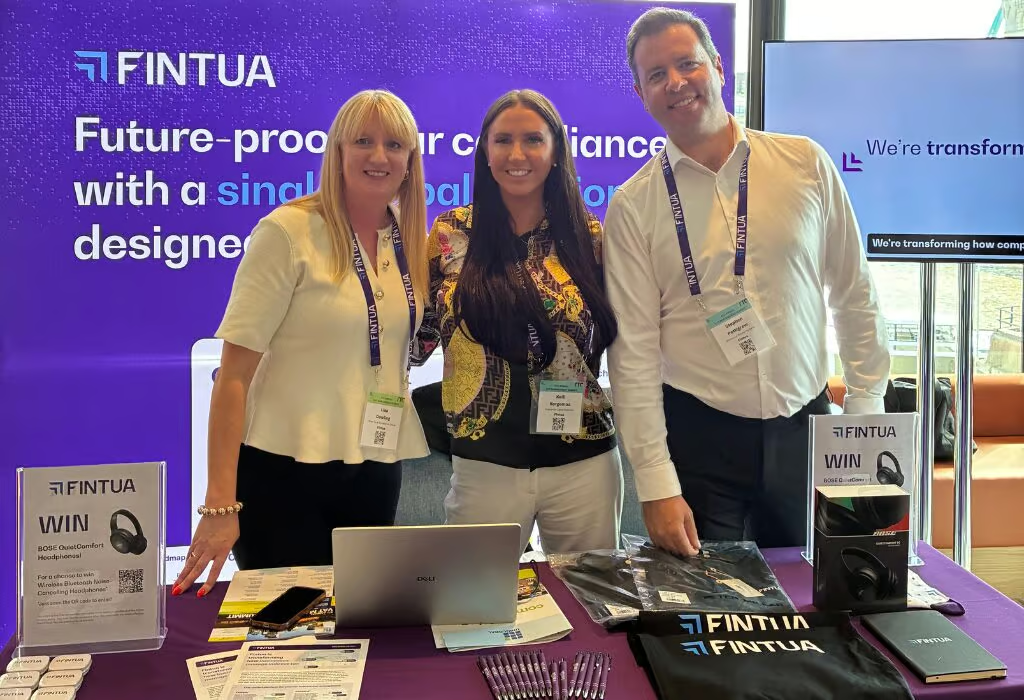

The 8th Annual VAT Management Summit in London on the 9th-10th June 2026 made one thing clear: the world of VAT is undergoing a fundamental transformation and it’s happening faster than many organisations are prepared for.
A standout message that resonated throughout the event was around the importance of tax professionals having a seat at the table when technology decisions are being made:
“If you’re not at the table, you’re on the menu.”
It perfectly captures the urgency for tax professionals to play an active role in shaping the future of VAT within their organisations. Many tax teams are still not at the table and in 2026, this isn’t just a missed opportunity, it’s a risk.
The shift to real-time VAT compliance
One of the main themes of the summit was the acceleration of eInvoicing and Continuous Transaction Controls (CTCs), and how they are fundamentally changing the operating model of VAT. VAT compliance is no longer a periodic, retrospective exercise – it is now real-time, continuous and transactional.
During the panel discussion moderated by Lisa Dowling, Chief Tax & Compliance Officer at Fintua, “VAT in the Digital Reporting Era: Preparing for Continuous Controls,” it became clear that multinational organisations are still grappling with this shift – not because they don’t understand it, but because they haven’t fully operationalised it.
Tax authorities now have granular visibility into transactional data, so the margin for error is rapidly shrinking. Businesses are currently relying on delayed reconciliations, siloed systems and manual workarounds. These businesses must now operate in an environment where compliance is not only immediate but increasingly unforgiving. The disconnect is becoming more exposed and increasingly penalised.
What businesses are getting wrong:
• Assuming VAT processes will “adapt” to real-time reporting
• Underestimating how quickly enforcement capabilities are evolving
• Treating CTCs as a local compliance issue rather than a global operating model shift
From detection to prevention
Closely linked to this shift is the growing importance of reconciliation and continuous controls. As Mate Szimilko, Senior VAT Manager at Fintua, discussed during his presentation “The Future of VAT: eInvoicing, ViDA and the Power of Reconciliations”, these are no longer back-office tasks, they are critical capabilities that enable organisations to identify discrepancies before tax authorities do.
In this new landscape, proactive compliance is the only viable strategy and reconciliation especially between eInvoicing and VAT return data is essential in today’s compliance landscape. If tax authorities can spot discrepancies before you do, your controls aren’t working.
Data quality: The first line of defence
Another recurring theme was the importance of data quality. Data quality comes up repeatedly in tax transformation conversations, but it’s also one of the least acted on. Instead organisations are:
- Managing fragmented ERP environments
- Accepting weaker master data governance
- Relying on manual corrections downstream
As tax authorities leverage AI to enhance enforcement, the ability to detect inconsistencies and errors has never been stronger. This makes ERP systems, structured reporting and clean master data essential. Simply put, organisations cannot achieve compliance without getting their data foundations right. Data quality isn’t just a tax issue, it’s an enterprise issue.
AI and the importance of the human in the loop
AI was a major talking point throughout the summit. And while AI is transforming VAT compliance by automating processes and reducing manual effort, it also raises important questions about governance and control.
The consensus at the summit was clear:
- AI should augment, not replace, tax professionals. In other words, it should be a co-pilot and not an autopilot.
There is huge potential for tax teams to shift their focus toward higher-value, strategic activities. However, this requires ensuring that tax professionals have a seat at the table when technology decisions are being made. Tax teams do need to play in active role in terms of how AI is implemented and not just adopted, you don’t want to lose visibility and control over increasingly complex compliance processes.
Implementation is just the beginning
A key takeaway for many organisations is that implementation is no longer the finish line. It’s just the starting point. What follows is where most value is realised or lost:
- Adoption across the business
- Optimisation of processes
- Continuous improvement
- Readiness for future regulatory changes
VAT transformation shouldn’t be treated as a once-off project, but instead a long-term, ongoing process. In a rapidly evolving landscape, standing still is not an option.
ViDA and the urgency to act
The EU’s VAT in the Digital Age (ViDA) initiative is acting as a major catalyst for change. Although 2030 may seem like a distant deadline, the message from the summit was clear:
- If you’re waiting until then, you’re already too late.
Organisations need to act now to build the capabilities required for the future of VAT and avoid being left behind. This mean standardising processes, addressing data quality issues and aligning tax with broader digital transformation initiatives.
Getting the fundamentals right
Several speakers emphasised that successful tax transformation depends on aligning four critical pillars:
- People
- Process
- Technology
- Data
VAT transformation covers multiple functions but often ownership remains unclear. In many organisations:
- Technology sits with IT
- Data sits with finance or operations
- Processes are fragmented across the business
- Tax is expected to oversee outcomes without controlling inputs
Clear ownership is so important and so is cross-functional collaboration.
The evolving role of tax professionals
As VAT becomes more digital and real-time, the role of the indirect tax professional is changing. No longer confined to just compliance, tax professionals are increasingly expected to play a critical role in shaping and influencing technology decisions, ensuring that tax requirements are embedded into core finance and ERP systems from the outset rather than retrofitted later. This requires closer collaboration with IT, finance and operations teams, breaking down traditional silos and positioning tax as an integral part of enterprise-wide digital transformation.
Beyond operational responsibilities, tax professionals are also becoming strategic advisors. With both organisations and tax authorities increasingly leveraging AI and advanced analytics, tax teams must interpret complex data outputs, identify risk patterns and provide forward-looking insight that informs business decisions. They are expected to navigate rapidly evolving regulatory requirements in real time, ensuring that organisations remain compliant in a landscape where authorities can detect inconsistencies and anomalies faster than ever before.
As we discussed in a recent blog, VAT strategy can become competitive advantage for organisations with the right tools and people in place.
Final thoughts
The message from the summit was clear: VAT is no longer just a compliance function. it is a strategic capability.
Organisations that invest early in data quality and control frameworks, embed tax into transformation decisions and take ownership of VAT as a strategic capability will be best positioned to succeed in this new environment.
And for tax professionals, the takeaway is simple:
Make sure you’re at the table.
Work with indirect tax experts
Navigating global indirect tax doesn’t have to be complicated. At Fintua, our dedicated team brings clarity to compliance. Whether you’re expanding into new markets or streamlining existing obligations. We combine expert insight with tailored technology to support businesses in a digital-first landscape. Whatever the jurisdiction, whatever the challenge – we’re ready.
Subscribe to our newsletter
Stay informed about the latest VAT news, trends and topics from around the globe with our monthly newsletter. Each month, we deliver insightful updates straight to your inbox, helping you stay ahead of the curve.
Authors


Helen Long
As Fintua’s Content Marketing Manager, Helen creates content that helps tax and finance professionals stay informed of the ever-changing world of VAT.



Lisa Dowling
Specialising in International VAT Compliance solutions, Lisa brings a wealth of knowledge and insight in her dealings with a host of international clients ranging from start-ups through to multinationals. With 24 years VAT experience behind her, Lisa has managed VAT compliance issues and solutions globally for over 14 years. Fintua have 12,000 + corporate clients in over 109 countries and many of these are members of the Fortune 500.

Máté Szimilkó
With a decade of experience in VAT compliance across both Big 4 firms and technology-driven service providers, Máté has progressed from preparer to manager, gaining deep insights into the sector’s challenges and opportunities. He consistently views complexity as a chance to improve quality and efficiency, leading projects and driving continuous advancement at Fintua in all aspects of VAT compliance, from sales discussions to return preparation and notifications.