
For many CFOs, VAT compliance is still viewed as a regulatory necessity, a cost to manage, a risk to mitigate and an obligation to fulfil. Monthly and quarterly returns, manual reconciliations, spreadsheet workarounds and reactive audit responses have long been the norm.
But that mindset is changing.
As Lisa Dowling, Chief Tax & Compliance Officer and Máté Szimilkó, Senior VAT Compliance Manager at Fintua, discussed in their recent webinar, VAT intelligence: Turning compliance into competitive advantage. When powered by the right technology and guided by deep human expertise, VAT strategy can become a source of business insight and competitive advantage, particularly for CFOs navigating increasingly complex global operations.
The shift from reactive reporting to strategic value
Over the years, VAT compliance has changed from backward-looking reporting to real-time, data-driven visibility. So, what’s driving this change?
Firstly, the VAT environment itself has evolved and with it, the urgency of new regulations. The rollout of initiatives such as ViDA (VAT in the Digital Age) and the global wave of mandatory eInvoicing mean tax authorities now expect granular, transaction-level data often in real time. The days of manually adjusting and submitting VAT returns are effectively over as manual processes simply can’t keep up.
But this regulatory pressure also creates opportunity. Historically, VAT was backward-looking, focused on what happened last month or last quarter. Today, technology enables standardised processes across multiple countries and systems, providing CFOs with a unified real-time overview of their global business operations, cash flow and supply chains. VAT moves from being a compliance output to a proactive dashboard that influences and drives major business decisions.
Where VAT technology delivers measurable value
1. Cash flow and faster refunds
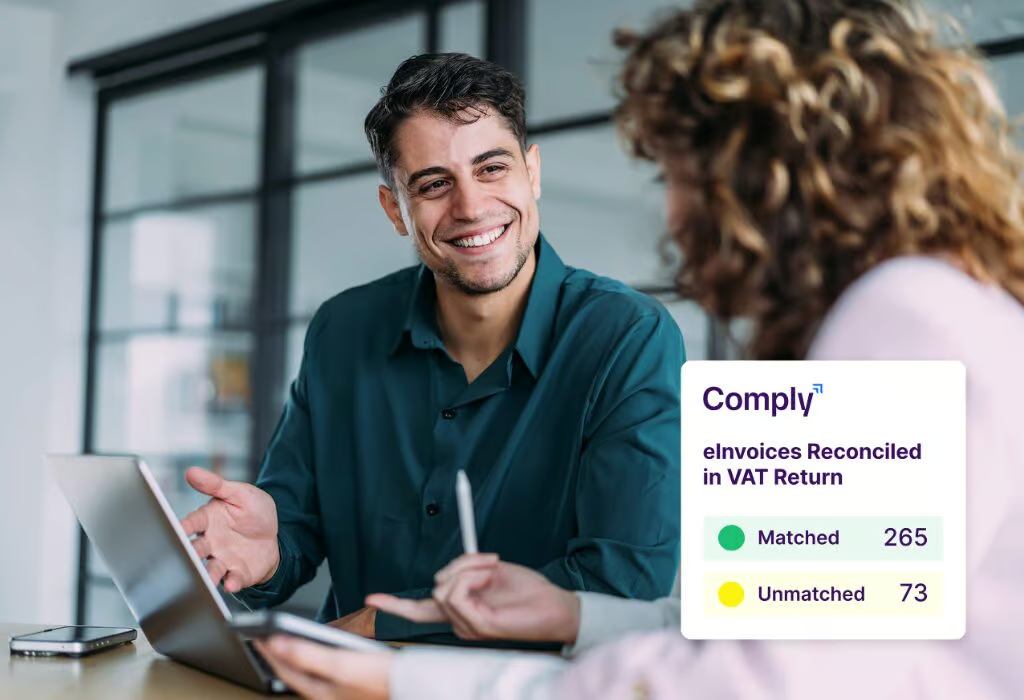
VAT directly impacts working capital – when its paid, when it’s recovered and how accurately it’s managed. With real-time eInvoicing, reconciliation becomes more complex and more critical. Differences can arise due to rejected invoices, corrections across periods or exchange rate movements. Technology can be used to mitigate these risks and receive VAT refunds faster.
“With a standardised VAT technology stack, you can automatically flag these discrepancies, know exactly why they occurred and explain them to the tax authority before they even ask. That proactive stance builds credibility, leading to reduced audit friction and quicker turnarounds on VAT refunds”
– Máté Szimilkó, Senior VAT Compliance Manager, Fintua
2. Operational insight beyond tax
VAT data often highlights issues that sit completely outside of tax. Incorrect VAT treatment can point to problems in master data, pricing or tax code classification.
When VAT data is structured and visible, tax teams can advise the business proactively. Máté shared examples where small changes in product composition could shift VAT treatment from standard to reduced or zero rates, directly improving margins or price competitiveness. The well-known UK “Jaffa Cakes” case may be decades old, but the lesson remains a powerful reminder that understanding VAT can materially change commercial outcomes.
3. Speed, agility and market expansion
In fast‑moving sectors, particularly digital services, VAT obligations are emerging rapidly in new jurisdictions. Countries such as Togo, Morocco, Malawi and Turkey have introduced or updated eInvoicing requirements with extremely short lead times.
Manual spreadsheet-based VAT processes make expansion a massive headache. In contrast, standardised and automated systems scale with the business, enabling faster market entry rather than slowing it down. In this sense, VAT technology becomes an enabler of growth rather than a barrier.
The key, according to Lisa, is to
“Embrace the technology, standardise your processes, standardise your data, understand your data, and that will really help you to be able to adapt to the changes that are coming”.
– Lisa Dowling, Chief VAT & Compliance Officer, Fintua
Why technology alone isn’t enough
Despite its benefits, technology alone doesn’t replace human judgement. As Máté puts it,
“Technology executes, but it doesn’t think for you”.
VAT logic such as rules, interpretations and treatments still comes from people. If that logic is wrong, technology will simply scale errors at lightning speed.
Human expertise is still essential:
- To design the VAT logic embedded in systems
- To interpret grey areas and complex cross-border transactions
- To explain and defend VAT positions during audits
Your people understand your business better than any system. While technology enables speed, visibility, agility and standardisation, it should support the experts, freeing them to focus on higher-value activities rather than manual checks.
Governance: The foundation of trust
Strong VAT governance is crucial in a technology-driven compliance environment. Governance is what makes technology reliable. Clear ownership, documented processes, defined controls and standardises audit trails build confidence both internally and with tax authorities.
Good governance delivers tangible benefits:
- Better data quality
- Reduced penalty exposure
- Fewer escalations into audits
- Smoother audit interactions
- Faster VAT refunds
The role of AI is co-pilot, not autopilot
AI is becoming an integral part of VAT compliance particularly for anomaly detection, reconciliation and pattern recognition across vast datasets. As Máte explains:
“AI is a co-pilot, not an autopilot”.
AI can spot duplicated invoices, mismatched tax codes or unusual transaction spikes, but accountability doesn’t sit with the algorithm, it sits with the CFO and tax team. Human review, explanation and approval remain essential as tax authorities demand both speed and clarity.
The most effective approach is exception-based management:
- Technology automatically handles 90–95% of standard transactions
- Human experts focus on true anomalies and high‑risk exceptions
This apporach balances the speed of automation with the safety of human governance.
Repositioning VAT inside the organisation
To unlock VAT’s full value, CFOs must start with a mindset shift. VAT should not be an afterthought at the end of a transaction. It should be considered early at the design stage – from supply chains to pricing to decisions about where to locate warehouses or establish operations.
When VAT is invovled early:
- It enables better decisions
- It improves cash flow modelling
- It reduces friction and rework later
Standarsied data and processes, supported by technology, give CFOs with a clear global overview and allow the VAT function to operate as a strategic advisory function not a compliance bottleneck.
Key takeaways for CFOs
Manual VAT compliance is no longer viable. As real-time reporting, eInvoicing and initiatives such as ViDA accelerate, automation is becoming mandatory. However, sustainable value does not come from technology alone. It comes from technology combined with human expertise, supported by strong governance.
Every organisation is on a different automation and technology journey. This makes it challenging when regulatory initiatives push all businesses forward at the same pace whether they are ready or not. The good news is that progress doesn’t require a full system overhaul. Meaningful gains can start with small, practical steps: improving data quality, standardising datasets and aligning VAT processes across entities and jurisdictions.
When implemented correctly, VAT technology enables this standardisation and gives CFOs unprecedented visibility across the business. It transforms VAT from a reactive reporting obligation into a proactive strategic enabler supporting cash flow, operational insights and smarter decision making.
As Máté summarised at the close of the session
“Stop looking at VAT data as a compliance output. Treat it as a strategic asset. Standardise it, understand it and use it to guide the business forward.”
In a world of real‑time reporting, VAT intelligence isn’t optional. It’s a competitive advantage for organisations ready to look beyond compliance.
Ready to turn VAT into a strategic asset?
Talk to our experts about building a smarter, technology-driven VAT approach for your business.