
Ireland is entering a new chapter in VAT modernisation. With EU-wide digital reporting reforms accelerating, the Irish Revenue is working closely with businesses to prepare for a more digital, real-time VAT environment.
At our recent ELEVATE event, Karen Dunne and Davena Lyons from the Office of the Revenue Commissioners shared insights into their roadmap, strategic objectives and what businesses should expect as Ireland transitions to eInvoicing.
Here’s a recap of the session.
A new era for VAT in Ireland
Ireland’s VAT administration has remained largely unchanged since the 1970s, relying on periodic, retrospective reporting. Current returns capture limited cumulative data – including sales, purchases, intra-EU transactions and customs – which constrains real-time visibility and risk management.
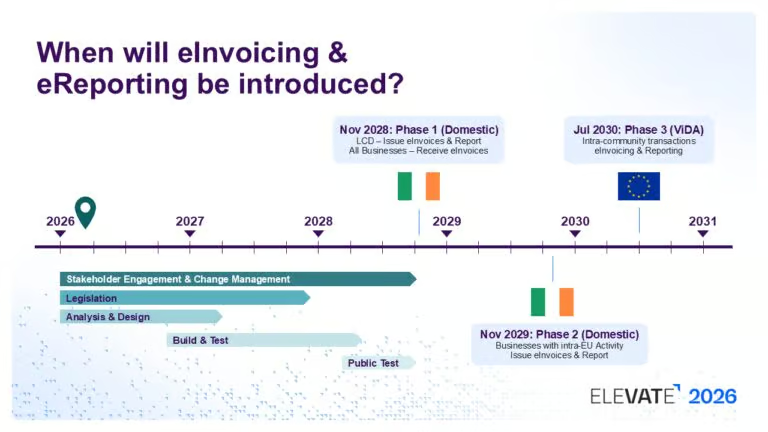
The introduction of eInvoicing marks a significant shift. Revenue is preparing Irish businesses for a domestic eInvoicing and reporting regime starting November 2028, ahead of the EU-wide ViDA (VAT in the Digital Age) implementation in July 2030. The goals are clear: harmonisation, standardisation, interoperability and fraud prevention, while supporting digitalisation, productivity and competitiveness for businesses.
eInvoices are structured data files, not PDFs, aligned with the EN 16931 standard, providing more accurate, high-quality data for both businesses and tax administrations.
Implementation roadmap
Revenue outlined a phased approach:
1. Phase One (November 2028) – Large corporates in Ireland (approximately 2,400 businesses) will be mandated to adopt eInvoicing. This ensures the most complex and high-volume businesses are ready in advance, protecting zero-rated intra-EU VAT.
2. Phase Two (July 2030) – All businesses with domestic VAT obligations will start eInvoicing and reporting, aligning with ViDA’s intra-EU requirements.
Revenue is also conducting surveys and engaging directly with large corporates to understand current invoicing processes, volumes and IT systems. This ensures adequate preparation and smooth onboarding across the business ecosystem.
Progress and EU collaboration
Ireland is leveraging lessons from other EU countries that have implemented eInvoicing, including Poland, Italy, Spain, Portugal and Greece. These insights inform Ireland’s domestic approach and help avoid common pitfalls.
Revenue is participating in a ViDA pilot using the Peppol network, an EU-wide framework that standardises electronic document exchange. This pilot tests the integration of ViDA reporting elements with existing business systems, promoting harmonisation and reducing compliance costs for cross-border trade.
Key next steps for businesses
Revenue emphasised that preparation is critical:
- Process mapping: Businesses should analyse existing invoicing workflows, ERP systems and data storage.
- Data readiness: Assess what information is already captured in invoices and what adjustments are needed to comply with EN standards and ViDA requirements.
- Cross-department coordination: Finance, IT and tax teams, and even executive leadership, must collaborate to implement change effectively.
- Engagement: Revenue encourages businesses to reach out early, particularly during the design phase, to raise sector-specific concerns or challenges.
Revenue also plans to issue clear guidance, maintain a dedicated information hub on their website and engage through business associations, software providers, and practitioner networks.
What this means for businesses
The shift to eInvoicing represents both a challenge and an opportunity:
- Reduced risk & increased accuracy: Real-time reporting improves compliance and reduces errors.
- Business intelligence: Structured data can enhance analytics, forecasting and operational efficiency.
- Digitalisation & competitiveness: Early preparation can provide a strategic advantage in a rapidly digitalising EU VAT landscape.
Businesses that start planning today – mapping processes, cleaning data and aligning IT systems – will be best placed to meet the November 2028 deadline and the full ViDA mandate in 2030.
Final thoughts
Ireland’s VAT modernisation is a carefully phased, collaborative effort, balancing EU alignment with domestic readiness. Revenue is committed to working closely with businesses, providing guidance and ensuring a smooth transition to eInvoicing.
For businesses looking to engage or clarify requirements, Revenue is available for consultation via vatmodernisation@revenue.ie.
The message is clear: eInvoicing is coming, and preparation is key. Early action today will make compliance tomorrow seamless and position businesses to thrive in a digital VAT environment.
Watch on-demand
Authors

Davena Lyons
Davena Lyons is a Principal Officer in the Revenue Commissioner’s Collector General’s Division, with over 23 years of experience across a diverse range of remits. She is responsible for business delivery and change management of Revenue’s VAT Modernisation programme, including implementation of the EU’s VAT in the Digital Age (ViDA) and Ireland’s domestic roll-out of eInvoicing. She oversees Revenue’s VAT repayments, the Division’s contact centre and debt management programmes. She has significant experience in delivering large scale national priorities, including the administration of the Debt Warehousing Scheme and pandemic and energy business support schemes. Earlier roles included leading multiple teams across audit and compliance, insolvency, analytics and policy development.


Karen Dunne
Karen Dunne is a senior manager at Ireland’s Office of the Revenue Commissioners with over 18 years of public service, responsible for a portfolio of EU‑mandated VAT programmes, including the VAT One Stop Shop (OSS) schemes, the VAT Information Exchange System (VIES), and the VAT SME scheme. Drawing on a career that combines hands-on IT application development across internal platforms and public-facing services with operational experience in the Collector General’s Division, she is centrally involved in modernising Ireland’s VAT administration. Karen also oversees the business implementation of the European Commission’s VAT in the Digital Age (ViDA) proposals, ensuring legislative changes are effectively embedded in Revenue’s internal processes and systems.


Helen Long
As Fintua’s Content Marketing Manager, Helen creates content that helps tax and finance professionals stay informed of the ever-changing world of VAT.