
The digital economy has transformed how businesses create, deliver and capture value. But for tax authorities and finance teams alike, it has also redefined how VAT is applied, collected and reported.
As businesses expand online and cross borders without a physical footprint, VAT systems built for traditional trade are being tested like never before. Understanding this shift is essential for anyone involved in indirect tax, finance, e-commerce or VAT compliance for digital services.
The digital shift and why VAT matters more than ever
From streaming services and software subscriptions to online marketplaces and gig-economy platforms, digitalisation has blurred the lines between goods and services, local and global.
VAT, designed to tax consumption where it happens, must now adapt to a world where transactions take place in the cloud. This shift has driven significant VAT reforms worldwide, from One Stop Shop (OSS) schemes and remote-seller registration regimes to marketplace deemed-supplier rules and digital reporting obligations.
The goal is to ensure fair taxation, level the playing field between domestic and international sellers, and reduce VAT gaps caused by unreported digital sales.
The challenges of VAT in the digital economy
The complexities of VAT in the digital economy are vast.
1. Defining reportable supplies, scope and place of supply:
The digital economy is evolving rapidly and the scope of VAT continues to expand. What began as rules targeting electronically supplied services, such as software and online advertising, now increasingly extends to platform-facilitated services, and in some jurisdictions, goods and services arranged through online marketplaces.
The online trade of goods is also being brought into scope, with country-specific low-value thresholds and varying rules on who is responsible to account for VAT – the supplier, the customer or, in some cases, the platform itself. VAT may be collected at the point of import through customs procedures or through VAT reporting obligations, depending on the jurisdiction.
Determining the place of taxation requires businesses to meet country-specific criteria, while the party responsible for accounting for VAT can vary depending on the type of transaction and the status of the customer.
In many jurisdictions, non-established suppliers must also verify their customer’s business status and, in some cases, submit Control Lists or transaction reports for B2B supplies for audit purposes.
2. VAT compliance for online marketplaces:
More countries now classify platforms as deemed suppliers for VAT purposes, making VAT compliance for marketplaces increasingly complex and shifting compliance responsibilities from sellers to the platforms themselves. In practice this means marketplaces may be required to collect, report and remit VAT on behalf of third-party sellers, while also meeting additional reporting and data-sharing obligations with tax authorities. Increasingly, platforms are becoming an extension of the VAT compliance process rather than simply facilitating transactions.
As platform liability expands globally, businesses selling through marketplaces must understand where responsibility shifts from the seller to the platform and where obligations remain with the underlying supplier.
3. Cross-border thresholds and registration:
Businesses operating in the digital economy often face multiple VAT obligations across different jurisdictions, creating significant digital VAT compliance challenges for international sellers.
Monitoring and analysing these constantly changing country-specific requirements demands significant time and resources. In some cases, legislation remains ambiguous, leaving room for interpretation and uncertainty rather than clear guidance.
In certain jurisdictions, the obligation to collect VAT may not align with other rules determining place of supply or liability for payment, creating inconsistencies between supplier and customer responsibilities.
Even where regulations are clearly defined, the procedures to register and report VAT can still cause difficulties. Dedicated e-portals, while intended to simplify compliance, can introduce technical hurdles such as authentication errors, access setup issues and platform outages.
In countries where non-established digital economy traders must follow the general VAT regime, compliance becomes more complex. Local fiscal representatives may be required and filing costs can be significant, especially for businesses with only occasional cross-border transactions.
4. Further obligations – Real-time reporting, eInvoicing and record keeping:
An increasing number of countries require real-time reporting and eInvoicing to improve visibility and reduce fraud. In some countries, these requirements apply to non-established traders. Local recordkeeping rules can also vary, including requirements around retention periods, data accessibility and in some cases, local storage or synchronised copies.
For many digital-first businesses, manual VAT compliance processes simply can’t keep up with this level of complexity and regulatory change. Remaining compliant often means allocating significant resources and managing increased compliance risk, even for occasional cross-border transactions.
Global responses: A patchwork of regulation
To ensure fair competition for local traders and improve VAT collection in the rapidly growing digital economy, countries worldwide are expanding regulations to cover digital services and e-commerce platforms. This includes widening the scope of taxable supplies and increasing reporting obligations for platforms and traders.
In 2026, the focus has shifted beyond simply taxing digital services. Tax authorities are increasingly strengthening platform liability rules, expanding registration requirements for non-resident supplier and introducing more detailed reporting obligations.
- Azerbaijan: Has adopted amendments introducing mandatory VAT registration and collection obligations for qualifying nonresident providers of electronic services, with the regime applying where relevant thresholds are exceeded.
- Brazil: From 1 August 2026 (pilot phase) and 1 January 2027 (full implementation), platforms may be required to register and account for tax when acting as a deemed supplier, while financial institutions may act as tax collectors.
- Botswana: Botswana introduced VAT rules for remote services from 1 June 2026, with non-resident registration obligations and VAT collection expected from 1 October 2026 at 14%.
- Kazakhstan: Kazakhstan introduced VAT registration for foreign companies supplying goods or services through internet platforms from 1 January 2026.
- Malawi: From 14 April 2026, VAT applies to listed B2C digital services supplied by non-resident providers.
- Mauritius: Mauritius has applied 15% VAT to digital and electronic services supplied by foreign suppliers to customers in Mauritius from 1 January 2026.
- Morocco: From 11 June 2026, VAT applies to B2C remotely provided services.
- Rwanda: Rwanda introduced VAT rules for goods and services provided online, requiring nonresident sellers to register directly or appoint a local representative.
- Saudi Arabia: Saudi Arabia has expanded electronic marketplace deemed-supplier rules, including supplies facilitated by platforms on behalf of certain non-VAT-registered resident suppliers from 1 January 2026.
- Sri Lanka: From 1 July 2026, VAT applies to B2C remotely provided services provided by non-residents.
Together, these changes show that digital VAT compliance is becoming more fragmented, data-driven and operationally demanding. For businesses selling across borders, the challenge is no longer simply knowing whether VAT applies. It is knowing who is liable, where the customer is located, when registration is triggered, what evidence must be retained and how quickly reporting obligations must be met.

The role of automation in modern VAT compliance
As the digital economy accelerates, so does the demand for automated VAT compliance solutions. Managing VAT compliance for digital services, online marketplaces and cross-border sales requires technology that can adapt to rapidly changing regulations.
- Determine the correct VAT treatment based on customer location, supply type and transaction flow
- Track local thresholds and registration triggers across multiple jurisdictions
- Identify when marketplace liability VAT rules and deemed-supplier obligations apply
- Maintain audit-ready customer-location evidence
- Support eInvoicing, real-time reporting and local filing requirements
- Integrate with ERP, billing, e-commerce and marketplace systems so VAT logic is applied consistently at source.
This is where Fintua comes in – helping organisations simplify the complex, stay compliant across markets, and focus on growth rather than administration.
The future of VAT in the digital economy
Looking ahead, VAT in the digital economy will become increasingly connected, data-driven and real-time. Tax authorities will continue to gain greater visibility into transactions through eInvoicing, platform reporting and digital reporting regimes.
For VAT and finance professionals, success in this new era will depend on agility, the ability to adapt processes, embrace automation and anticipate regulatory change rather than react to it.
Final thoughts
The digital economy has redefined how value is created, delivered and consumed, and VAT compliance is evolving to keep pace. For businesses operating online, understanding these changes isn’t just about avoiding penalties. It is about protecting margins, maintaining market access, improving audit readiness and building tax processes that can keep pace with global growth.
As tax authorities continue to expand digital reporting, platform liability and remote-seller obligations, manual VAT processes will become increasingly difficult to sustain. Businesses that invest in automation now will be better placed to manage the complexity of digital VAT compliance, respond to regulatory change and operate with confidence across borders.
Fintua empowers organisations to navigate this landscape with clarity, confidence and compliance.
About Fintua
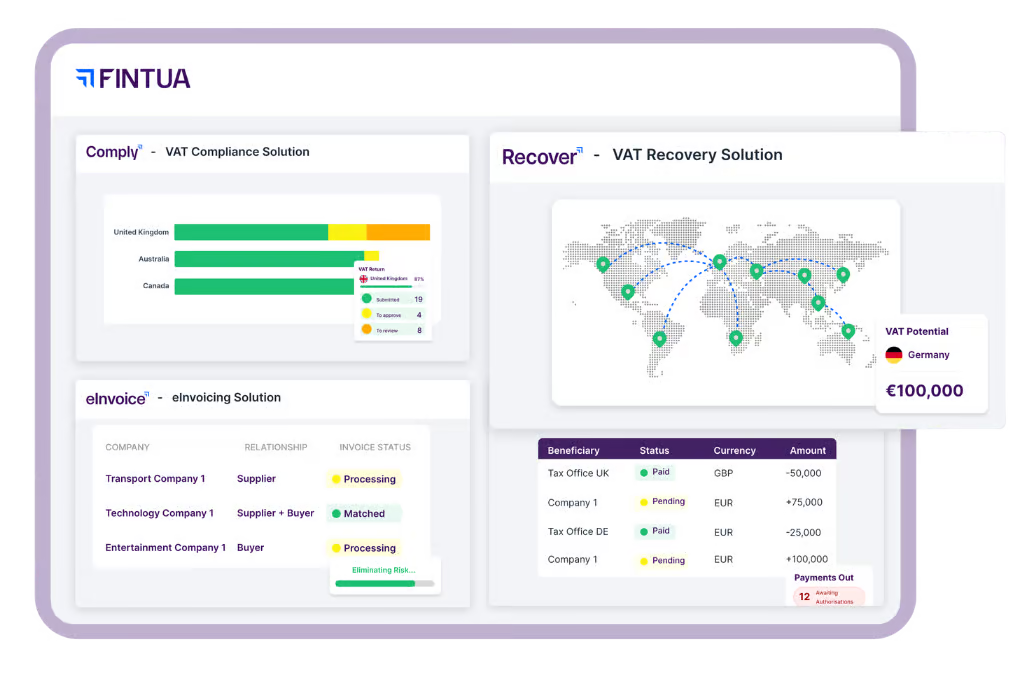
At Fintua, our solution Comply automates the end-to-end VAT compliance process across 180+ jurisdictions. This helps save hours of manual effort, boost accuracy and efficiency across the VAT process, enabling your team to focus on higher-value, strategic initiatives.
Subscribe to our newsletter
Stay informed about the latest VAT news, trends and topics from around the globe with our monthly newsletter. Each month, we deliver insightful updates straight to your inbox, helping you stay ahead of the curve.
Authors


Darina Ivanova
Darina leads Fintua’s Tax R&D function. She has more than 20 years of experience in VAT and indirect taxes, gained across multiple areas – compliance and recovery, tax determination, consultancy and appeals. Over the course of her career, she has supported clients of all sizes – SMEs, large enterprises, and multinationals – across diverse business sectors on VAT matters on local, regional, and global level. Within the Tax R&D function, Darina ensures Fintua’s products and processes evolve sustainably in line with the dynamically changing tax landscape.


Helen Long
As Fintua’s Content Marketing Manager, Helen creates content that helps tax and finance professionals stay informed of the ever-changing world of VAT.