Hungary VAT guide
The Hungarian VAT system is governed primarily by Act CXXVII of 2007 on VAT and administered by the Hungarian Tax and Customs Administration (NAV).
Menu
What is the VAT rate in Hungary?
27%
The standard VAT rate in Hungary is 27% which is the highest standard rate in the European Union. The standard rate applies for most of the goods and services.
Reduced rate: 18%
Applies to certain goods and services, including food products and selected accommodation services.
Reduced rate: 5%
Applies to specified categories of goods and services, including certain food products, books, newspapers, residential property transactions, internet access services and other qualifying supplies.
0% rate
Applies to exports and intracommunity supplies of goods.
Exempt categories
Activities in public interest, such as health, education and other listed activities such as finance and insurance.

VAT registration in Hungary
Resident businesses
Businesses carrying out taxable activities in Hungary must generally obtain a Hungarian tax number. Eligible businesses may opt for the individual VAT exemption scheme where turnover does not exceed the HUF 20 million threshold. Businesses using the exemption generally do not charge Hungarian VAT but are also restricted from recovering input VAT.
Non-established businesses
There is generally no VAT threshold in Hungary for non-established businesses and VAT registration is generally required from the first taxable supply in Hungary, unless a simplification, reverse charge mechanism, OSS scheme, or other exemptions apply.
Cross-border SME exemption
EU-established businesses may qualify for Hungary’s cross-border SME exemption regime where all applicable conditions are met, including:
- Hungarian turnover remaining within the Hungarian SME threshold, and
- Total eligible EU turnover remaining within the Union-wide threshold of €100,000.
Distance sales and eCommerce
Businesses carrying out cross-border sales of goods are not required to register for VAT if their total intra-EU distance sales of goods and Telecommunications, broadcasting and electronically supplied (TBE) services are below the €10,000 threshold. Once exceeded, VAT must be accounted for in the customer’s country via OSS or local VAT registration.
One-Stop Shop (OSS): The OSS scheme allows businesses to report eligible EU cross-border B2C sales through a single VAT return filed in one Member State instead of registering separately in multiple countries.
Import One-Stop Shop (IOSS): The IOSS scheme may be used for qualifying distance sales of imported goods contained in consignments with an intrinsic value not exceeding €150.
VAT return filing and deadlines
VAT returns must be submitted electronically to NAV. In Hungary, the filing frequency depends on the taxpayer’s status and statutory criteria
- Where the annual net VAT payable is below HUF 250,000, the filing frequency is annual.
- Where the annual net VAT payable is between HUF 250,000 and HUF 1,000,000, the frequency is quarterly.
- Where the annual net VAT payable is HUF 1,000,000 or more, the filing frequency is monthly.
Newly VAT-registered taxpayers generally file monthly returns during the initial period of registration.
Deadlines
- Monthly and quarterly VAT returns are due by the 20th day of the month following the reporting period.
- Annual VAT returns are are due by 25 February of the following year
- If a deadline falls on a weekend or public holiday, it is deferred to the next working day
- Filing extensions are generally not available

eInvoicing requirements
Hungary does not currently operate a universal mandatory B2B eInvoicing system.
However:
- Public-sector entities must accept compliant electronic invoices where required by law.
- Certain electricity and natural gas suppliers must issue electronic invoices to non-private customers.
- Businesses remain subject to Hungary’s real-time invoice-reporting requirements.
Real-Time Invoice Reporting (RTIR)
Hungary operates a real-time invoice reporting (RTIR) system known as Online Számla, which is a core VAT compliance requirement. Invoice data must be transmitted electronically to NAV for invoices falling within the scope of Hungarian invoice-reporting rules.
For invoices generated by invoicing software, reporting is generally automated and occurs immediately after issuance.
Manual invoices remain subject to separate reporting deadlines prescribed by NAV.
Businesses should ensure their invoicing systems remain connected to the Online Számla platform and that invoice data is transmitted correctly.
Exemptions and special cases
Certain transactions reported via the One Stop Shop (OSS) for cross-border B2C supplies may be excluded from Hungarian real-time reporting obligations.
Comply – Global VAT compliance management
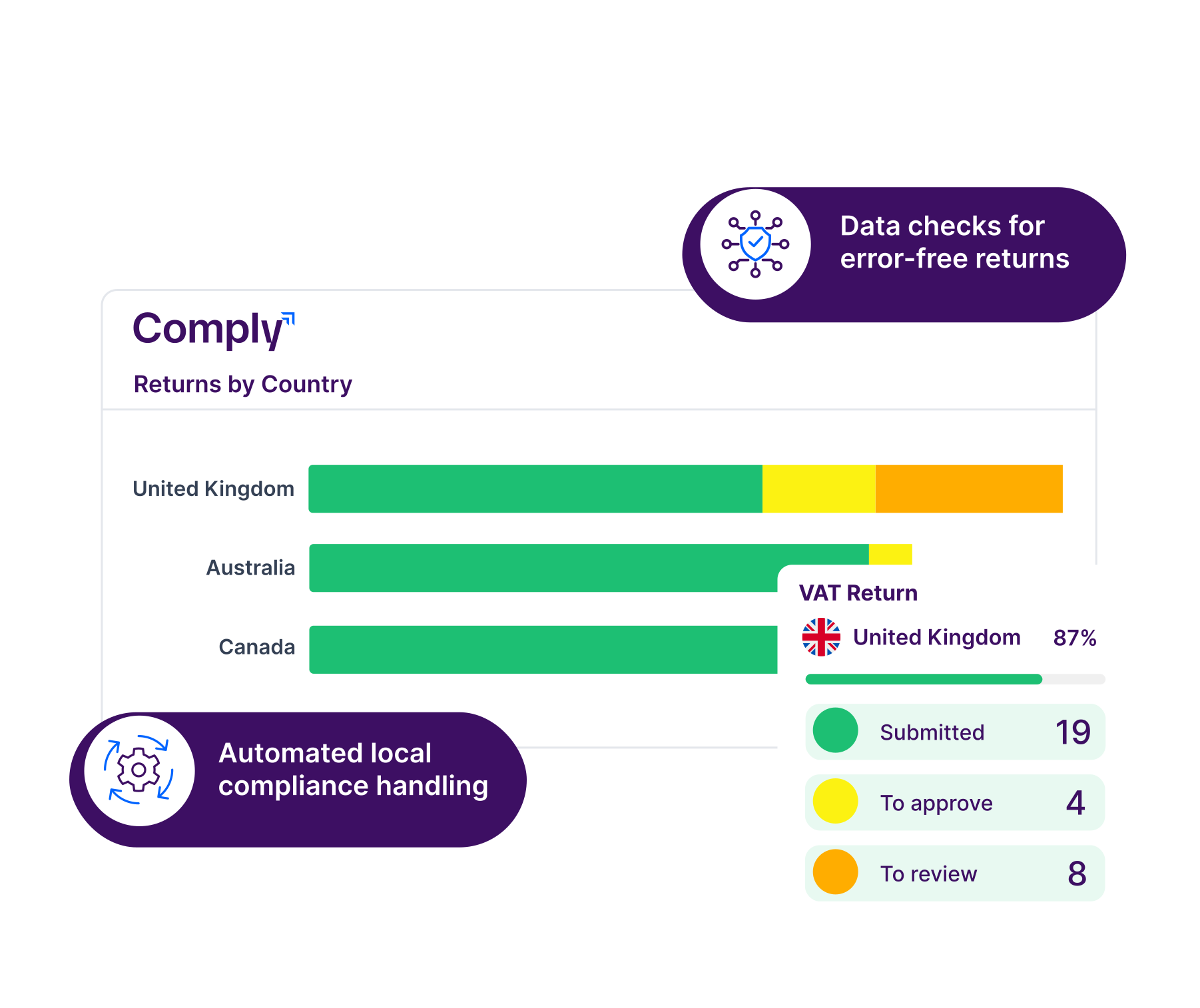
Our VAT compliance solution, Comply helps companies manage their complex, country-specific tax requirements including Hungary’s VAT obligations.
Using AI and machine learning, our technology puts your VAT data through over 300 automated VAT rules, checking for errors, and preparing VAT returns for approval and submission. Comply provides a full audit trail for the Hungarian Tax Authorities.
Record keeping requirements
Businesses must maintain VAT records, invoices, supporting documentation and accounting records required by Hungarian law.
Records should be retained for the statutory retention period and be made available to NAV upon request.
Businesses using OSS, IOSS or other special schemes should also retain the records required under the applicable EU regulations.
EKAER transport reporting
Hungary operates the Electronic Public Road Trade Control System (EKAER), introduced in 2015 by the Hungarian Tax Authority. Its purpose is to reduce VAT fraud in the road transport industry by monitoring the movement of goods transported on public roads.
EKAER reporting is generally required only for goods classified as notifiable goods, as defined by Hungarian legislation.
Failure to comply with EKAER reporting obligations, or incorrect reporting may result in significant penalties of up to 40% of the value of the transported goods.
Receipt data reporting
From 1 September 2026, Hungary requires the reporting of data relating to receipts issued through:
- Manual receipts books, and
- Computer generated receipt systems
Receipt data must generally be reported to NAV within the prescribed statutory deadline and in the format specified by NAV. This obligation is separate from the Online Számla invoice-reporting regime.
VAT penalties
Late or missed VAT returns may trigger penalties ranging from HUF 100,000 to 500,000. Late VAT payments are subject to daily interest at 1.8% calculated on the overdue amount.
Where VAT is incorrectly reported, the tax authority may impose a fine of up to 50% of the underpaid VAT, in addition to late-payment interest. This penalty is reduced by 50% if the error is disclosed voluntarily.
Fiscal representatives
In general, a fiscal representative is required by most non-EU established businesses
VIES declarations
VIES filing frequency is monthly or quarterly, depending on the value of intra‑EU transactions. VIES must be submitted by the 20th calendar day after the end of the reporting period. If the deadline falls on a weekend or public holiday, it is deferred to the next working day.
Intrastat
Registration and submission
Businesses must submit Intrastat reports when movements of goods within the EU exceed specified thresholds.
Intrastat Thresholds for 2026
Arrivals: HUF 5,000,000,000
Dispatches: HUF 200,000,000
Statistical value reporting thresholds
Arrivals: HUF 9 billion
Dispatches: HUF 15 billion
Deadlines and frequency
VIES filing frequency is monthly and must be submitted by the 15th calendar day following the end of the reporting period.
Rise Above the Rest
Maximise your potential with our full suite

VAT compliance solution
Rise above complex indirect tax challenges with Comply, Fintua’s revolutionary platform for global indirect tax compliance.

VAT recovery solution
Recover automates the process of identifying and reclaiming VAT on business expenses, both domestically and internationally, helping you boost your bottom line.

Integrated payments solution
Pay simplifies international payments, reducing complexity and costs while ensuring compliance with local regulations and improving financial visibility.

eInvoicing solution
eInvoice enhances efficiency by digitising your einvoicing process, ensuring compliance across multiple jurisdictions and improving cash flow management.