
As eInvoicing mandates in Europe accelerate, the difference between a smooth transition and last-minute disruption often comes down to preparation.
In December 2025, 425,000 Belgian businesses scrambled to join the Peppol network in a single month ahead of the national eInvoicing mandate. Yet, by March 2026, 17% of VAT-registered businesses were still non-compliant and exposed to penalties. Belgium’s experience is not unique. This rush-to-the-deadline pattern is being played out across Europe. With mandates arriving faster, changing how invoices are issued, received and reporting to tax authorities, what sets successful eInvoicing implementations apart? While the rules vary country-by-country, the challenges are consistent.
Drawing on real-world eInvoicing implementation experience, here are the key lessons to keep in mind when planning for eInvoicing mandates.
Align stakeholders before choosing technology
One of the most common reasons eInvoicing projects struggle is a lack of early alignment between tax, finance and IT. Historically, tax was often seen as an afterthought. Businesses were focused on selling first and worried about reporting and filing returns later. eInvoicing changes that completely as it sits at the centre of core business processes including:
- Sales invoicing
- Procure‑to‑Pay (P2P) processes
- Accounts receivable and accounts payable
- VAT reporting and audit files
Because eInvoicing data is often cleared or validated by tax authorities in real-time, it becomes an essential part of how you do business in a country, not something that sits in the background. Without early alignment between stakeholders, gaps will appear and show up as delays, rework or last-minute panic when a mandate goes live.
“Implementing eInvoicing with clients has shown us that success isn’t driven by technology alone, it’s driven by alignment. While the technical integration is often the easiest part, the real value comes from bringing finance, IT and the relevant teams together to standardise their data, manage change effectively and co-design processes that are as seamless as they are compliant”.
Eoin Dunphy, Senior VP of Customer Experience at Fintua
Design for country-specific rules, not global assumptions
eInvoicing is not one single global standard. Each country has different requirements on:
- What an electronic invoice must contain
- Which mandatory fields are required (such as VAT identification numbers or business identifiers)
- The technical format – often XML
- Whether invoices must be cleared by the tax authority before reaching the customer
For example, in countries like Poland, invoices are submitted through the national system KSeF and are validated before they are accepted. If required fields are missing or incorrect, the invoice is rejected. This means that a one-size-fits all approach doesn’t work. Businesses need country-specific compliance strategies supported by flexible technologies.
Data quality becomes a compliance risk
A recurring challenge for businesses is master data quality. Many organisations discover too late that key data points, such as validated business identifiers, are missing or inconsistent across systems. In Europe, frameworks such as Peppol place a strong emphasis on these identifiers for monitoring, reporting and VAT control. eInvoicing therefore becomes a data and regulatory challenge, not just a document format change. Accuracy from the outset is critical as there’s little opportunity to fix errors later.
Reconciliation between VAT returns and eInvoicing data
eInvoicing and Continuous Transaction Controls (CTCs) are reshaping VAT reporting from periodic summaries into real-time, transaction-level transparency. As a result, VAT returns are expected to align directly with eInvoicing and real-time reporting data.
This shift introduces new reconciliation challenges. Differences in timing, tax treatment, and data quality can create mismatches between invoice-level data and VAT return totals. At the same time, inconsistencies between reported data sources are far more visible to tax authorities.
As a result, audits are evolving as tax authorities can now identify discrepancies earlier requiring businesses to maintain continuous alignment between transactional data and VAT reporting.
Map your existing systems before you implement
eInvoicing does not sit in isolation, it depends on your systems already in place. Large organisations often operate mulitple ERPs, local billing engines or country-specific solutions. Some jurisdictions are so complex that they already require standalone setups.
Before implementing eInvoicing, companies need to answer some basic but critical questions.
- Where are invoices generated today?
- Where does VAT reporting data come from?
- Where does master data live and who owns it?
- How do non‑standard invoices flow through the system?
Upcoming mandates will force organisations to look at their current setup and decide how it needs to evolve. Using these mandates to shape your systems, rather than adding them on later, leads to more robust solutions.
Data accuracy is the biggest risk
The quality of your data should not be underestimated. eInvoicing requires data to be complete and correct at the point of issue and there is very little room for manual fixes later. And eInvoicing is often only the first step. Many countries require additional
- Reconciliation requirements
- Digital reporting
- Audit or SAF‑T style files
In practice, most issues with eInvoicing implementation arise not from high‑volume, standard transactions, but from exceptions. Common examples include:
- Employee expenses where invoices might be duplicated
- Intercompany transactions that sit outside standard billing systems
- Year‑end or adjustment entries that do not follow normal flows
Thousands of invoices may flow through without issue, but one or two non‑standard documents can create compliance risk if they are missed.
Automation reduces risk and effort
Manual work does not scale in an eInvoicing environment, particularly where transaction volumes are high or mandates are strict.
Automated and integrated solutions reduce the likelihood of errors and allow invoices to move seamlessly between ERP systems, eInvoice platforms and tax authorities. They also support consistency across countries and business units.
Where possible, automation should cover both outbound and inbound invoices, as well as any reporting that follows on from eInvoicing.
Prioritisation keeps eInvoicing projects on track
eInvoicing mandates do not arrive evenly. Some countries move faster than others, and lead times can be short.
Successful eInvoicing programmes start with clear prioritisation:
- Which countries to tackle first
- Which countries are live or approaching go-live
- Where transaction volumes or risk are highest
- What your system is going to look like from an architecture and technology perspective
- Making sure all teams are involved
Just as important is scope control. eInvoicing projects often attract new ideas as more stakeholders get involved. While those ideas may add value, short implementation timelines mean that scope creep can derail delivery.
Strong project management and a clear roadmap are essential.
Get the right people involved early
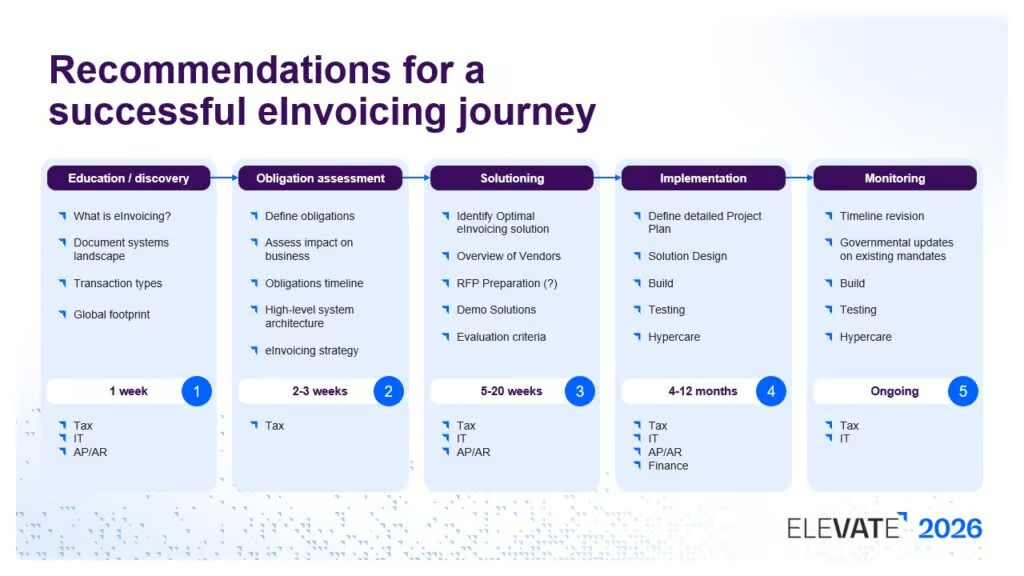
Across all eInvoicing implementations, the same stakeholder groups consistently play a role:
- Tax
- Accounts payable (AP) / Accounts receivable (AR)
- Finance
- IT and engineering
- Product owners, where multiple systems are involved
Each group has different priorities. Tax focuses on compliance and deadlines. Finance looks at payments, vendor setups and operational impact. IT evaluates system changes and development effort.
Bringing these voices into the vendor selection process early helps surface gaps, clarify costs and ensure the solution works across the business. If you’re assessing eInvoicing providers or planning for upcoming mandates, our guide outlines the key capabilities to look for.
When in-house capacity is limited, external support matters
Not every organisation has the IT bandwidth or specialist knowledge needed to manage eInvoicing mandates across multiple countries. In those cases, outsourcing parts of the process to an external eInvoicing provider can make sense. A well‑integrated service can:
- Connect to existing ERP systems
- Stay up to date with changing mandates
- Reduce the regulatory compliance burden
- Provide confidence as rules evolve
Given how frequently eInvoicing and digital reporting requirements change, that reassurance can be as valuable as the technology itself.
Learn from each implementation
One of the biggest advantages of early implementations is the ability to build a repeatable model. Each rollout provides insight into timelines, data issues and stakeholder engagement. Over time, this creates a template that can be reused as new countries introduce mandates.
With mandates accelerating globally, this kind of template approach is becoming essential.
Final advice: Preparation is the competitive advantage
The companies that succeed in eInvoicing are not the ones that move fastest at the deadline, they’re the ones that prepare early.
The closing advice for rolling out a successful eInvoicing implementation is straightforward:
- Know your business and where you sell
- Align tax, finance and IT early
- Invest in data quality and governance
- Choose partners carefully
- Build a clear roadmap
- Plan for change, not just compliance

eInvoicing solution
Have a question? Ask our experts and they’ll get back to you within 24 hours

Subscribe to our newsletter
Stay informed about the latest VAT news, trends and topics from around the globe with our monthly newsletter. Each month, we deliver insightful updates straight to your inbox, helping you stay ahead of the curve.
Authors


Lisa Dowling
Specialising in International VAT Compliance solutions, Lisa brings a wealth of knowledge and insight in her dealings with a host of international clients ranging from start-ups through to multinationals. With 24 years VAT experience behind her, Lisa has managed VAT compliance issues and solutions globally for over 14 years. Fintua have 12,000 + corporate clients in over 109 countries and many of these are members of the Fortune 500.