
The finance and tax sector is at a pivotal moment in its digital transformation journey. AI is rapidly moving beyond rule-based automation, manual data preparation and static dashboards toward intelligent, insight driven systems that can help VAT teams make better decisions, faster. But with VAT errors subject to regulatory scrutiny and costly penalties, adopting AI responsibly is crucial.
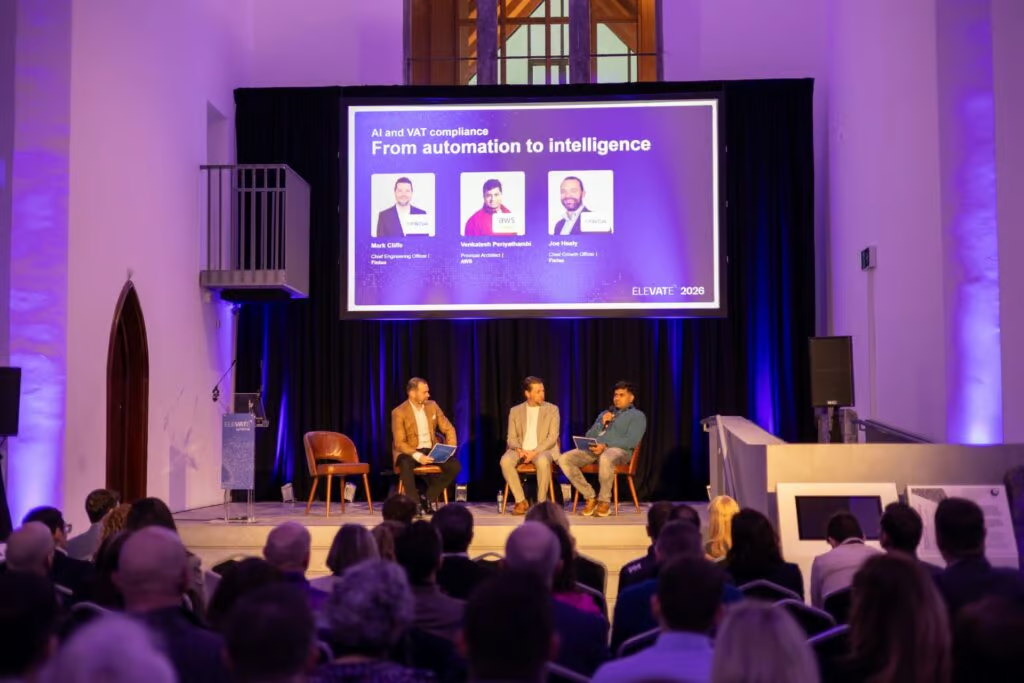
At ELEVATE 2026, industry experts Mark Cliffe (Chief Engineering Officer at Fintua) and Venkatesh Periyathambi (Principal Data Solutions Architect at AWS) shared their insights on how AI is reshaping the VAT compliance landscape and what tax teams should know to ensure successful AI adoption.
Define your golden source data
Organisations adopting AI should begin with identifying their golden source data.
“Everything starts with golden source data.”
Poor data foundations are the primary reason that 70% of AI projects fail. AI cannot compensate for bad data. VAT teams must identify, clean and maintain their core datasets as a source of truth record to yield results that are consistent and reliable.
“If the source data is terrible then the results from an automation tool will be terrible as well.”
When choosing golden source data VAT teams must prioritise:
- Data quality: ensure accuracy, consistency and traceability
- Mandatory field completeness: populate all essential fields
- Clear definitions: align terminology across teams and systems
- Good ERP hygiene: use enforced fields and structured datasets wherever possible
Data literacy and domain expertise
Both Venkatesh and Mark emphasised the importance of data literacy and domain expertise for building intelligent systems.
For successful AI adoption VAT teams must understand what each data element represents, how it is used and how it should be mapped across systems. Organisations must also establish clear and consistent definitions for data fields across teams.
As Venkatesh explained during the session:
“What we have to understand is that currently all of these models are probabilistic. They’re very good at predicting what’s next. Whereas in your field, you don’t want to predict, you want to be factual. It’s very important to have domain expertise.”
Intelligent VAT systems cannot be built in isolation. Development teams and VAT experts must work side by side, combining technical capability with subject matter expertise. The strongest grounding for successful adoption comes with good quality data, a clear understanding of what each field means and domain expertise to explain any variances that may occur.
What becomes possible when the data is right
AI models are typically trained on public data while VAT relies on organisation specific definitions and rules. To bridge this gap, VAT teams must create a data pipeline that ingests, cleans and standardises data before categorising it into bronze, silver and gold layers to train machine learning models.
With high-quality, well-structured data, tax teams can achieve:
- Reconciliation at scale
- Behavioural insights
- On-demand reporting
Practical steps for tax teams
1. Start early
Begin experimenting with AI on small, low-risk processes. Start by using AI to write Excel formulas or simple reports to gradually build knowledge with prompting.
2. Build single-use agents first
Start with single-use agents where mistakes don’t have major consequences, as confidence grows scale to enterprise level AI applications.
3. Always keep a human in the loop
When using AI VAT professionals must remain vigilant about GDPR, data residency and model behaviour. A human must stay in the loop to review outputs.
Final thoughts
AI is not here to replace VAT professionals, it’s here to empower.
When clean data, unified definitions, strong governance and human expertise are in place, AI becomes a powerful tool for tax teams. It helps teams work faster, spot risks earlier, navigate complexity with confidence and elevates the standard of VAT compliance across the board.
Watch on-demand
Ready to streamline VAT compliance for your business?
Talk to Fintua about how we help businesses streamline compliance operations, increase efficiency and navigate regulatory change with confidence.
Authors


Mark Cliffe
Mark is a senior engineering leader with over 25 years of experience delivering scalable, high-performance software in regulated, data-sensitive industries. As Chief Engineer at Fintua, he leads the modernisation of enterprise platforms to enable international growth and seamless client onboarding. Mark has a proven track record in building systems that support high-volume transactions with near-limitless scalability. He combines deep technical expertise with a strategic mindset, leveraging cutting-edge technologies to deliver secure, reliable, and future-ready solutions. Known for developing high-performing global teams, Mark ensures strong governance, continuous innovation, and alignment between technology and business success.



Venkatesh Periyathambi
Venkatesh Periyathambi is a Principal Data & AI Solutions Architect with over 15 years of experience delivering large-scale cloud data platforms for enterprise organisations. He has led complex migration programmes on AWS, bridging legacy systems with modern, cloud-native ecosystems. A recognised thought leader at the intersection of data architecture and enterprise AI, Venkatesh is a frequent conference speaker and author of blogs and technical whitepapers on database migration, modernisation, and AI-powered knowledge systems.


Sinéad Power
As a Marketing Assistant at Fintua, Sinéad creates content to help businesses navigate the evolving indirect tax landscape.