Latvia VAT guide
Latvia introduced Value Added Tax (VAT) in 1995. Latvian VAT legislation is based on EU VAT directives, as Latvia has been a member of the European Union since 1 May 2004.
VAT in Latvia is governed by the national VAT Law and administered by the State Revenue Service (Valsts ieņēmumu dienests), which operates under the Ministry of Finance.
Menu
What is the VAT rate in Latvia?
21%
Standard VAT rate: 21%
Reduced VAT rates: 12% and 5%.
The 12% reduced rate applies to selected goods and services, including medicines, books, heating supplies, and accommodation services.
The 5% reduced rate applies to certain agricultural products, including fresh fruit, berries and vegetables.
Flat-rate scheme for farmers:
A 14% flat-rate compensation percentage applies to farmers who are not VAT-registered. This mechanism allows them to recover input VAT indirectly rather than charging VAT on their supplies.

VAT registration in Latvia
Businesses must register for VAT in Latvia if their taxable turnover exceeds €50,000 in a 12-month period. Registration must be completed by the 15th day of the month following the month in which the threshold is exceeded.
Voluntary VAT registration is also possible before reaching this threshold.
Cross-border thresholds
- Distance sales (B2C): Businesses carrying out cross-border B2C supplies of goods or services within the EU are not required to register in Latvia if their total EU-wide turnover remains below €10,000. Once this threshold is exceeded, VAT must be accounted for in the customer’s country via the One Stop Shop (OSS) scheme or local registration.
- Intra-Community acquisitions: Non-taxable persons and partially exempt businesses must register for VAT in Latvia if their intra-Community acquisitions exceed €10,000 per year.
- Electronically supplied services: Electronically supplied services fall under the EU-wide €10,000 threshold for cross-border B2C supplies and are covered by the OSS scheme.
Deadlines and VAT filing frequency
VAT returns are generally filed quarterly.
Monthly returns can be filed where a taxable person carries out intra-community supplies exceeding €50,000 per year.
VAT returns and payments must be submitted by the 23rd day of the month following the end of the reporting period.
VAT-registered businesses must submit an EU Sales List (ESL) if they carry out intra-Community supplies of goods or services to VAT-registered customers in other EU Member States. ESLs are generally submitted monthly. The submission deadline is the 20th day of the month following the reporting period
Intra-Community acquisitions must be reported in the VAT return. Additional Intrastat reporting may apply where statistical thresholds are exceeded.

eInvoicing requirements for Latvia
Latvia is implementing mandatory eInvoicing and digital reporting in a phased approach.
- Since 1 January 2025, structured eInvoicing is mandatory for business-to-government (B2G) transactions
- From 2026, eInvoice data reporting to the State Revenue Service (VID) is required for government-related transactions
Future developments
- Voluntary B2B eInvoicing is available from 2026
- Mandatory B2B eInvoicing and reporting will apply from 1 January 2028
Invoices must be issued in a structured electronic format (XML), typically based on the European standard EN 16931 and the PEPPOL BIS Billing 3.0 framework.
Comply – Global VAT compliance
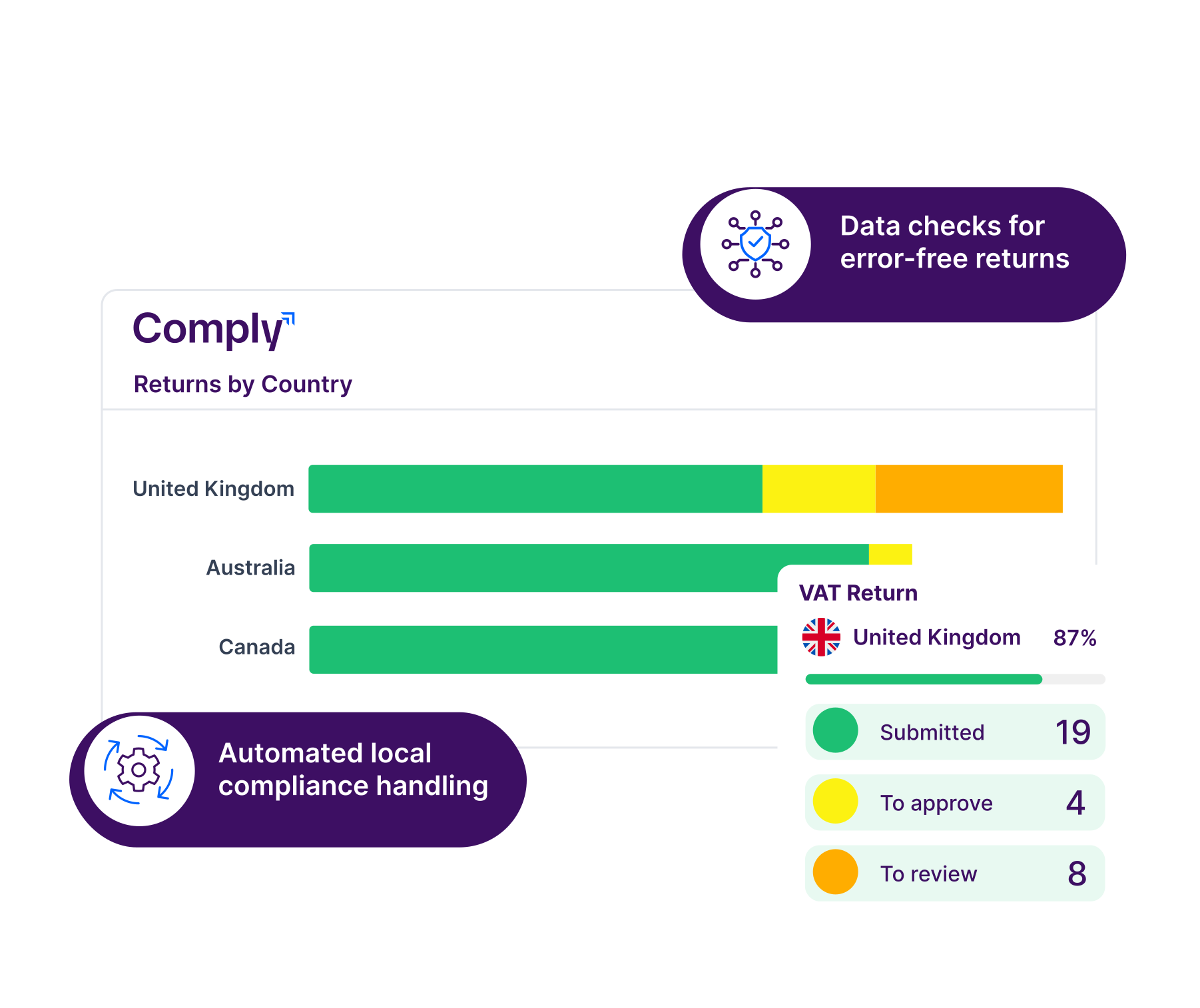
Our VAT compliance solution, Comply helps companies manage their complex, country-specific tax requirements including Latvia’s VAT obligations.
Using AI and machine learning, our technology puts your VAT data through over 300 automated VAT rules, checking for errors, and preparing VAT returns for approval and submission. Comply provides a full audit trail for the Latvian Tax Authorities.
Agents and fiscal representatives
Businesses in Latvia may appoint a local VAT agent or authorised representative to assist with VAT compliance, including registration, filing obligations and communication with the tax authorities.
EU-established businesses are not required to appoint a fiscal representative and may register for VAT directly in Latvia.
Non-EU businesses are generally not required to appoint a fiscal representative in Latvia and may register for VAT directly in their own name.
However, the appointment of a local representative is often recommended in practice to facilitate compliance with local VAT requirements.
IOSS
The Import One Stop Shop was introduced on 1 July 2021 as part of the EU VAT e-commerce reforms. The scheme allows businesses to register in a single EU Member State in order to declare and pay VAT due on distance sales of imported goods across the EU through a single monthly return.
IOSS applies to:
- Goods not subject to excise duties
- Distance sales of goods to consumers (B2C)
- Goods located outside the EU at the time of sale
- Consignments with an intrinsic value not exceeding €150
Where a supplier is registered for IOSS:
- VAT is charged at the point of sale and declared via the IOSS return
- Goods can be imported into the EU without payment of import VAT at customs
This simplifies VAT compliance and improves the customer experience by avoiding unexpected import charges.
Intrastat
Intrastat is a statistical reporting system used to collect data on the movement of goods between EU Member States. VAT-registered businesses in Latvia must submit Intrastat declarations when the value of their intra-Community trade exceeds specified thresholds.
The Intrastat thresholds in Latvia are:
Intrastat Arrivals
- Standard reporting threshold: €380,000
- Detailed reporting threshold: €5,500,000
Intrastat Dispatches
- Standard reporting threshold: €220,000
- Detailed reporting threshold: €7,500,00
Deadlines and frequency
Intrastat declarations in Latvia must be submitted monthly once the relevant thresholds are exceeded.
The deadline for submission is typically the 10th working day following the end of the reporting period
Rise Above the Rest
Maximise your potential with our full suite

VAT compliance solution
Rise above complex indirect tax challenges with Comply, Fintua’s revolutionary platform for global indirect tax compliance.

VAT recovery solution
Recover automates the process of identifying and reclaiming VAT on business expenses, both domestically and internationally, helping you boost your bottom line.

Integrated payments solution
Pay simplifies international payments, reducing complexity and costs while ensuring compliance with local regulations and improving financial visibility.

eInvoicing solution
eInvoice enhances efficiency by digitising your einvoicing process, ensuring compliance across multiple jurisdictions and improving cash flow management.