Malta VAT guide
In Malta, Value Added Tax (VAT) or Taxxa fuq il-Valur Mizjud in Maltese was introduced in 1998. Malta operates a VAT system that is aligned with the EU VAT Directive and administered by the Commissioner for Revenue.
Menu
What is the VAT rate in Malta?
18%
Standard VAT rate: 18%
Applies to most supplies of goods and services
Reduced VAT rates:
5% VAT rate: Applies to selected goods and services including certain medical products, printed materials and qualifying social services.
7% VAT rate: Generally applies to tourist accommodation and related qualifying services.
12% VAT rate: Applies to certain specified goods and services, including qualifying accommodation and other transactions prescribed under Maltese VAT legislation.
The 0% VAT rate applies to certain transactions including exports, certain intra-Community supplies and specific food products and qualifying supplies
Exempt supplies: Certain financial, insurance, healthcare and educational services may qualify for VAT exemption.

VAT registration in Malta
The Maltese VAT Act allows for three different types of registrations for VAT which are listed in Article 10, 11, 12 of the VAT Act.
Domestic businesses
Businesses carrying out taxable activities may be required to register for VAT under Malta’s Article 10 registration regime. Small businesses may qualify for exempt Article 11 registration where turnover remains below the applicable thresholds:
- €35,000 for businesses primarily supplying goods
- €24,000 for businesses supplying services with low value added
- €20,000 for other economic activities
Businesses registered under Article 11 do not charge VAT on their supplies and cannot recover input VAT incurred on business expenses. Businesses exceeding the applicable threshold must generally register under Article 10 and account for VAT on taxable supplies.
EU businesses
Non-established EU businesses carrying out taxable supplies in Malta may need to register from their first taxable transaction unless a simplification, reverse charge mechanism or special scheme applies.
Distance sales
Non-established EU businesses carrying out distance sales of goods into Malta do not have to register if annual distance sales remain below €10,000 across all EU Member States. Once the €10,000 EU-wide threshold is exceeded, VAT becomes due in the country of destination. Businesses must either register locally or use the One Stop Shop (OSS) scheme.
Non-EU businesses
Non-EU businesses generally have no VAT registration threshold. VAT registration may be required before making taxable supplies in Malta.
When does VAT liability apply?
VAT liability applies to the following transactions:
- Supply of goods or of services that takes place in Malta made by a taxable person acting as such
- Certain intra-community acquisitions (dispatches and arrivals)
- Importation
- Domestic reverse charge.

eInvoicing requirements
B2G eInvoicing is mandatory in Malta. Invoices to public entities must be structured in XML format, following the EN 16931 standard, and transmitted via the Peppol network.
Malta currently allows electronic invoicing subject to VAT invoicing requirements and authenticity controls.
There is currently no broad mandatory B2B eInvoicing framework similar to some other EU Member States. Businesses should monitor future developments linked to EU digital reporting initiatives.
EU VAT in the Digital Age (ViDA) reforms are expected to influence future digital reporting and electronic invoicing requirements across Member States
Comply – Global VAT compliance
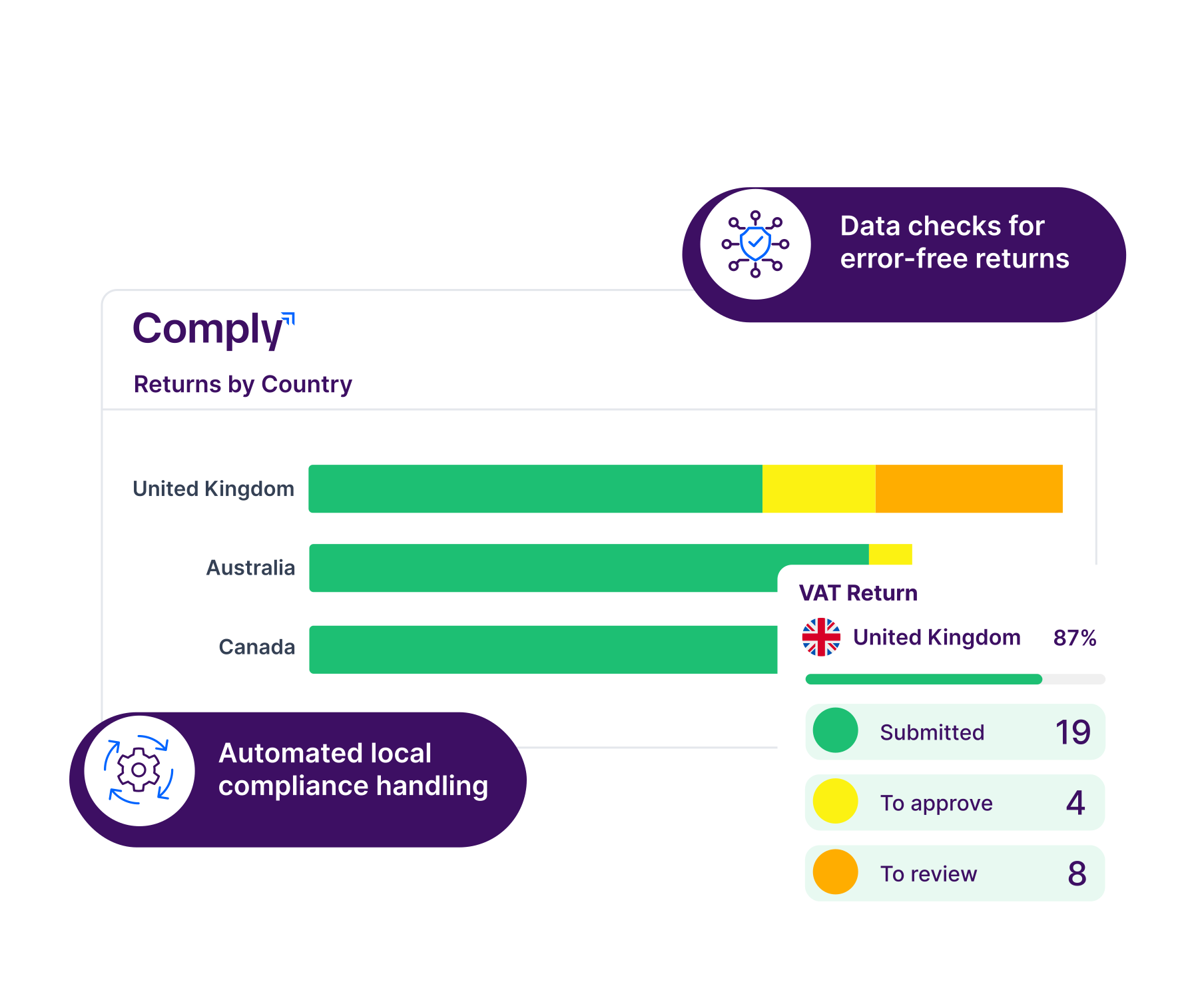
Our VAT compliance solution, Comply helps companies manage their complex, country-specific tax requirements including Malta’s VAT obligations.
Using AI and machine learning, our technology puts your VAT data through over 300 automated VAT rules, checking for errors, and preparing VAT returns for approval and submission. Comply provides a full audit trail for the Maltese Tax Authorities.
VAT return filing frequency
The filing frequency depends on the registration type.
Article 10
Article 10 registrants generally submit VAT returns on a quarterly basis.
Article 11
Article 11 registrants generally submit annual declarations.
Article 12
Article 12 registrants submit declarations in accordance with their registration obligations.
Submission deadlines
Article 10
VAT returns are generally due within 6 weeks of the end of the VAT period.
Article 11
Annual declarations are generally submitted following the end of the calendar year.
Article 12
Relevant declarations are submitted in accordance with the applicable statutory deadlines.
Any VAT payable is generally due within 6 weeks following the end of the VAT period, which corresponds with the VAT return submission deadline for Article 10 registered businesses.
Businesses should ensure that payment is made by the applicable deadline to avoid interest and penalties.
Fiscal representatives
Malta generally does not require a fiscal representative solely for VAT registration purposes, although businesses may choose to appoint a local tax adviser to assist with compliance obligations.
Intrastat
In Malta, an Intrastat declaration must be submitted as soon as the intra-community transaction amount reaches the threshold which is set by the Intrastat customs code.
The deadline for submission is the 10th working day of the month following the declaration period. When the thresholds for intra-community transactions are exceeded, an Intrastat declaration shall be filed during the month when the threshold was reached. The Maltese Intrastat threshold for arrivals and dispatches is set at €700 per return.
Rise Above the Rest
Maximise your potential with our full suite

VAT compliance solution
Rise above complex indirect tax challenges with Comply, Fintua’s revolutionary platform for global indirect tax compliance.

VAT recovery solution
Recover automates the process of identifying and reclaiming VAT on business expenses, both domestically and internationally, helping you boost your bottom line.

Integrated payments solution
Pay simplifies international payments, reducing complexity and costs while ensuring compliance with local regulations and improving financial visibility.

eInvoicing solution
eInvoice enhances efficiency by digitising your einvoicing process, ensuring compliance across multiple jurisdictions and improving cash flow management.