Across Europe, eInvoicing is rapidly transforming how businesses and tax authorities manage VAT. Driven by technology, compliance needs and cost efficiency, it is becoming the backbone of VAT reform.
The rise of eInvoicing
The adoption of eInvoicing for B2B transactions by both businesses and tax authorities is gaining momentum due to several key factors:
- Technological advancements: Businesses and tax authorities are increasingly leveraging new technologies to replace manual processes, enhancing efficiency and accuracy
- Process efficiency helps reduce administration and frees teams to focus on strategic work
- Lower operating costs result from phasing out paper-based workflows and speeding up payments
- Successful B2G adoption has paved the way for broader B2B implementation across the EU
- VAT fraud reduction is supported by real-time or near real-time data reporting. The EU VAT gap dropped from €99 billion in 2020 to €61 billion in 2021, partly due to digital reporting measures.
ViDA: Building a harmonised EU framework
Introduced by the European Commission in December 2022, the VAT in the Digital Age (ViDA) proposal aims to standardise eInvoicing and digital reporting requirements (DRR) across all Member States. Its first pillar focuses on real-time reporting for intra-Community transactions supported by structured eInvoicing.
Key objectives of ViDA pillar 1
- Mandatory, harmonised transaction-based digital reporting for intra-Community supplies, replacing monthly and quarterly recapitulative statements
- Optional reporting for domestic transactions, allowing Member States discretion in applying DRR domestically
- eInvoicing as the default method for issuing invoices
- A centralised VIES database to support secure cross-border data exchange.
Technical and regulatory requirements
Under ViDA, Member States must:
- Accept eInvoices using the EU standard in a structured electronic format
- Ensure eInvoices include all VAT Directive data requirements
- Permit other formats only if interoperable with the EU standard
- Allow taxpayers or intermediaries to carry out compliance checks.
Invoice issuance rules
- Cross-border invoices must be issued within 10 days of the chargeable event or advance payment
- Domestic issuance rules remain unchanged
- Additional required data includes:
-
Reference to triangular transactions where relevant.
-
Sequential numbering for corrective invoices.
-
Supplier bank details or payment identifiers (multiple allowed if applicable).
-
Digital reporting deadlines
Invoice data must be reported:
-
At the time the invoice is or should have been issued
-
For self-invoices: within 5 days of issuance (actual or expected)
-
For customers: within 5 days of receipt
EU Reporting models: Convergence under ViDA
To meet reporting obligations, Member States are adopting various models:
- Centralised government portals e.g. Italy, Romania and soon, Poland
- Dencentralised networks using a 4- or 5- corner model (France and Belgium planned for 2026)
ViDA implementation timeline
- July 2030: Full implementation of real-time digital reporting for intra-community transactions becomes mandatory
- January 2035: Member States with existing domestic systems must harmonise with ViDA standards.
The 4 and 5 Corner eInvoicing Model
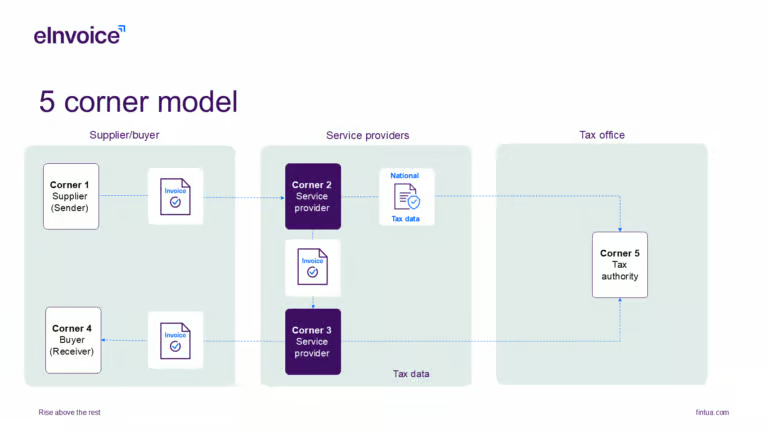
Peppol has developed models enabling sellers and buyers to connect through accredited service providers rather than state portals. This creates an interoperable network where:
- Businesses choose their own service providers
- eInvoices can be exchanged seamlessly across systems and borders
Peppol’s ViDA pilot
Peppol is currently testing a five-corner model aligned with ViDA Pillar 1:
-
Autumn 2024: Project planning and stakeholder engagement.
-
First half of 2025: Initial Digital Reporting Requirement (DRR) design.
-
Second half of 2025: Technical testing and validation phase.
Fintua is a proud member of Peppol, supporting interoperability and compliance innovation.
Conclusion
ViDA is reshaping VAT compliance through harmonised, structured eInvoicing and real-time reporting. As Member States continue adapting their domestic mandates, alignment through interoperable 4- and 5-corner models may accelerate a consistent EU-wide approach.
Stay informed on VAT reforms, eInvoicing mandates, and what they mean for your business. Subscribe to our newsletter for updates!