France VAT guide
VAT or Taxe sur la Valeur Ajoutée (TVA) was introduced in France in 1954 and extended across the economy in 1968. The tax is administered by the French tax authorities (DGFiP) under the Ministry of Economy and Finance.
Recent updates:
- eInvoicing: eInvoicing for B2B transactions for domestic companies is required from 1 September 2026. There is no eInvoicing obligation for B2C transactions, instead they are subject to eReporting obligations.
Menu
What is the VAT rate in France?
20%
Standard VAT rate: 20%
Reduced rates: 10%, 5.5%, 2.1%
10% rate for certain goods and services such as restaurant meals, passenger transport, hotel accommodation and some prepared foods.
5.5% rate applies to essential goods and services such as food products, books, water supply, certain energy supplies and medical equipment for disabled persons.
2.1% rate for specific items including certain reimbursable medicines and press publications.
Zero rate: 0%
Certain transactions are exempt from VAT with the right to deduct input VAT, including exports outside the EU and intra-Community supplies.
Exempt categories: Activities in public interest, such as healthcare, education as well as financial and insurance services.

VAT registration in France
Small business VAT exemption:
France operates a VAT exemption scheme that allows small businesses to operate without charging VAT when their annual domestic turnover remains below the following thresholds:
Deliveries of goods, on-premise sales and accommodation services:
- €85,000 in the previous calendar year
- €93,500 in the current calendar year
Other services:
- €37,500 in the previous calendar year
- €41,250 in the current calendar year
Specific activities of lawyers, authors and performing artists:
- €50,000 in the previous calendar year
- €55,000 in the current calendar year
Other activities of lawyers, authors, and performing artists
- €35,000 in the previous calendar year
- €38,500 in the current calendar year
These thresholds remain in place as of 2026. Proposals to introduce a single unified threshold have been withdrawn.
VAT registration obligations:
EU-established businesses
Businesses established in France or elsewhere in the EU must register for VAT when they carry out taxable transactions requiring registration (e.g. holding stock in France, making local supplies or exceeding distance selling thresholds without using OSS).
Distance sales
Non-established EU businesses carrying out distance sales of goods into France do not have to register if annual distance sales stay below €10,000 (EU-wide). Above this threshold, VAT is due in the country of destination (France), and businesses must either register locally or use OSS.
Non-EU businesses
Non-EU businesses must register as soon as they make taxable supplies in France, with no threshold. They may opt to use the One Stop Shop (OSS) if the scheme applies to their transaction flow.
VAT return filing and deadlines
France operates two VAT reporting regimes: General Regime and Simplified Regime.
General regime:
Businesses must apply the General Regime if:
- Annual turnover exceeds €840,000 (for goods) or €254,000 (for services), or
- Output VAT due exceed €15,000 in the previous year
Filing frequency:
- Monthly by default
- Quarterly may apply if annual VAT due is below €4,000
Deadlines
Deadlines differ depending on where the business is established:
- Non-resident businesses: VAT returns are generally due by the 19th day of the following month
- French-established businesses: deadlines typically fall between the 15th and 24th of the following month, depending on the tax office
Simplified regime:
Available to businesses below the General Regime thresholds and with lower VAT liabilities.
Filing frequency:
- One annual return
- VAT is paid via two instalments (June and December)
Annual return deadlines
The due date to submit Annual VAT return for the Simplified regime depends on the fiscal year.
- If fiscal year equals the calendar year, then the Annual Return should be submitted no later than the 2nd working day following 1 May of the following year.
- If fiscal years differs from the calendar year, then it needs to be submitted within 3 months after fiscal year has ended.
eInvoicing requirements
France’s eInvoicing mandate went live from 1 September 2026 with a phased implementation of mandatory eInvoicing and eReporting for VAT-registered businesses. The French tax authorities recently released guidance on September 2026 eInvoicing mandate.
eInvoicing applies to domestic B2B transactions between VAT-registered businesses established in France.
The following are not in scope for eInvoicing:
- B2C transactions
- Cross-border transactions
eReporting applies to:
Transactions not covered by eInvoicing, including:
- B2C sales
- Cross-border transactions
- Certain transactions carried out by non-established businesses subject to French VAT
eReporting data requirements
Businesses must report key transaction and payment data, including:
- Supplier and customer identification details
- Invoice number and date
- Gross amount
- VAT rate and VAT amount
- Nature of goods or services
- Payment date (Where applicable)
eReporting – Frequency and deadlines
For businesses under the standard VAT regime:
- 3 submissions per month (per decade):
- Transactions days 1–10 → report by the 20th
- Days 11–20 → report by the 30th (or next working day)
- Days 21–end → report by the 10th of the following month
Quarterly VAT filers
- Report monthly, by the 10th of the following month
Simplified VAT regime
- Report monthly, between the 25th and 30th of the following month
Implementation timeline
eInvoicing
- 1 September 2026: All businesses must be able to receive eInvoices. Large and mid-sized enterprises must issue eInvoices.
- 1 September 2027: SMEs and micro-enterprises must issue eInvoices
eReporting
- 1 September 2026: Applies to large and mid-sized enterprises
- 1 September 2027: Applies to small and micro-enterprises. Applies to most non-established businesses with French VAT obligations
- Non-established businesses: Not subject to eInvoicing. Must comply with eReporting where they carry out transactions taxable in France.
Comply – Global VAT compliance
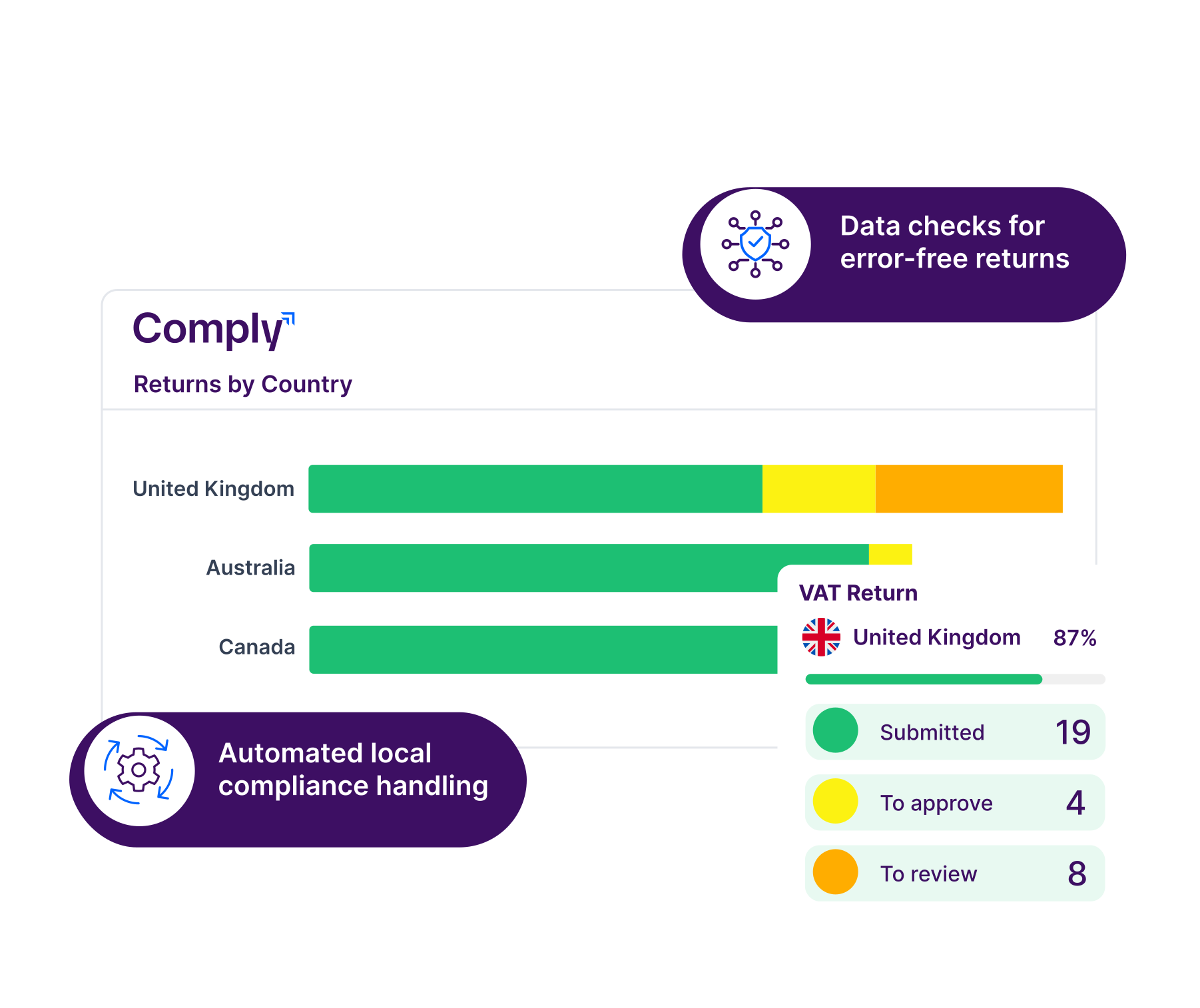
Our VAT compliance solution, Comply helps companies manage their complex, country-specific tax requirements including France’s Taxe sur la Valeur Ajoutée (TVA) obligations.
VAT penalties
Late filing penalties are applied as a percentage of the VAT due:
- 10% – if the return is filed late without prior formal notice, or within 30 days after receiving a formal notice
- 40% – if the return is not filed within 30 days after receiving a formal notice
- 80% – in cases involving hidden or undeclared activity
Late payment penalties:
- 5% surcharge applied to VAT paid after the deadline
- In addition, late payment interest applies at approximately 0.20% per month.
Fiscal representatives
Non-EU businesses are generally required to appoint a fiscal representative to handle VAT obligations in France.
Exceptions:
Businesses established in non-EU countries that have a mutual assistance agreement with France (covering VAT administrative cooperation and recovery) are not required to appoint a fiscal representative, though they may still choose to be assisted by a tax agent to assist with compliance.
These countries include (non-exhaustive)
Australia, India, Japan, Norway, Iceland, Mexico, South Korea, South Africa, United Kingdom, Kuwait, Pakistan, Ukraine and others depending on current agreements. Note that this list is subject to change based on international agreements. All VAT registrations and compliance obligations still apply.
EC Sales List (VIES declarations)
In France, EC Sales List (VIES declarations) referred locally as the “État récapitulatif TVA” (and DES for services), must be submitted monthly. The deadline is the 10th working day of the month following the reporting period.
Intrastat
Registration and submission
Since 1 January 2022, the obligation to file Intrastat (EMEBI) is no longer based on thresholds.
- Selection method: Businesses are selected by the French customs authorities through a sampling method
- Notification: Selected businesses receive a formal letter typically in December of the preceding year.
Deadlines and frequency
Selected respondents must submit declarations on a monthly basis by the 10th working day after the end each reporting period.
Rise Above the Rest
Maximise your potential with our full suite

VAT compliance solution
Rise above complex indirect tax challenges with Comply, Fintua’s revolutionary platform for global indirect tax compliance.

VAT recovery solution
Recover automates the process of identifying and reclaiming VAT on business expenses, both domestically and internationally, helping you boost your bottom line.

Integrated payments solution
Pay simplifies international payments, reducing complexity and costs while ensuring compliance with local regulations and improving financial visibility.

eInvoicing solution
eInvoice enhances efficiency by digitising your einvoicing process, ensuring compliance across multiple jurisdictions and improving cash flow management.