Italy VAT guide
In Italy, Value Added Tax (VAT) known as Imposta sul valore aggiunto (IVA) was introduced on the 1st of January, 1973.
IVA is a consumption tax which is administered by the Italian Ministry of Finance.
Menu
What is the Standard VAT (IVA) rate in Italy?
22%
Reduced rates: 10% and 5%
10% reduced rate applies to selected goods and services, including certain food products, hotel accommodation, restaurant and catering services, admission to cultural services, waste management and some construction and renovation works.
5% reduced rate applies to specific goods and services, including social, health and welfare services and select food products.
Super-reduced rate: 4%
4% applies to essential goods such as basic foodstuffs, certain agricultural products, books, newspapers and specific medical supplies.
Zero rate: 0%
Applies to exports and intracommunity supplies
Exempt categories: Activities in public interest, such as healthcare, education, financial and insurance services.

VAT registration in Italy
Resident businesses
Italy does not apply a general VAT registration threshold. Businesses must register for VAT from the commencement of taxable activities, regardless of turnover.
However, a flat-rate scheme (regime forfettario) is available to qualifying natural persons with annual revenues not exceeding €85,000. Businesses operating under this regime are generally exempt from charging VAT but are also not entitled to recover input VAT.
Non-established businesses
EU businesses: There is no VAT registration threshold in Italy for non-established businesses. EU businesses must register for VAT if they carry out taxable activities in Italy, unless reverse charge applies or they use the One-Stop Shop scheme (OSS) for eligible cross-border B2C supplies.
EU SME special scheme: Under the EU SME scheme (effective from 2025), small enterprises may avoid VAT registration in other EU Member States if:
- Their total annual EU-wide turnover does not exceed €100,000, and
- Their turnover in Italy does not exceed €85,000
Distance sales
Businesses carrying out cross-border B2C distance sales of goods are not required to register in Italy if their total EU-wide sales remain below €10,000. Once exceeded, VAT must be accounted for in the customer’s country via the OSS scheme or local VAT registration.
Non- EU businesses
Non-established, non-EU businesses must register for VAT in Italy from the first taxable supply, unless the reverse charge applies. OSS or IOSS schemes may be used where applicable.
How to obtain a VAT ID number in Italy?
In Italy, it is necessary to obtain a VAT number (Partita IVA) – an 11-digit code – to carry out business, agricultural, artistic or professional activities on a regular basis.
VAT registration is mandatory for anyone engaging in taxable activities in Italy, and must generally be completed before starting the activity or within a short period (typically within 30 days of commencement).
To obtain a VAT ID number, businesses must complete and submit a “Declaration of commencement, change of data or cessation of activity” to the Italian tax authority (Agenzia delle Entrate).
The declaration must include:
- Identification details of the taxpayer
- The code for the type of activity to be carried out (ATECO code)
- The place of business
Once processed, the Agenzia delle Entrate assigns the VAT number, which must be used on all invoices and official documents.
VAT scheme registration
The OSS (One Stop Shop) and the IOSS (Import One Stop Shop) are optional EU VAT schemes available in Italy. They allow businesses to declare and pay VAT due in multiple EU Member States through a single registration in one Member State.
These schemes apply to certain transactions:
- OSS applies to cross-border B2C supplies of services and intra-EU distance sales of goods
- IOSS applies to distance sales of imported goods (with a value not exceeding €150)
Registration for OSS and IOSS in Italy is carried out electronically via the Italian tax authority (Agenzia delle Entrate), using its online (telematic) services.
Comply – Global VAT compliance
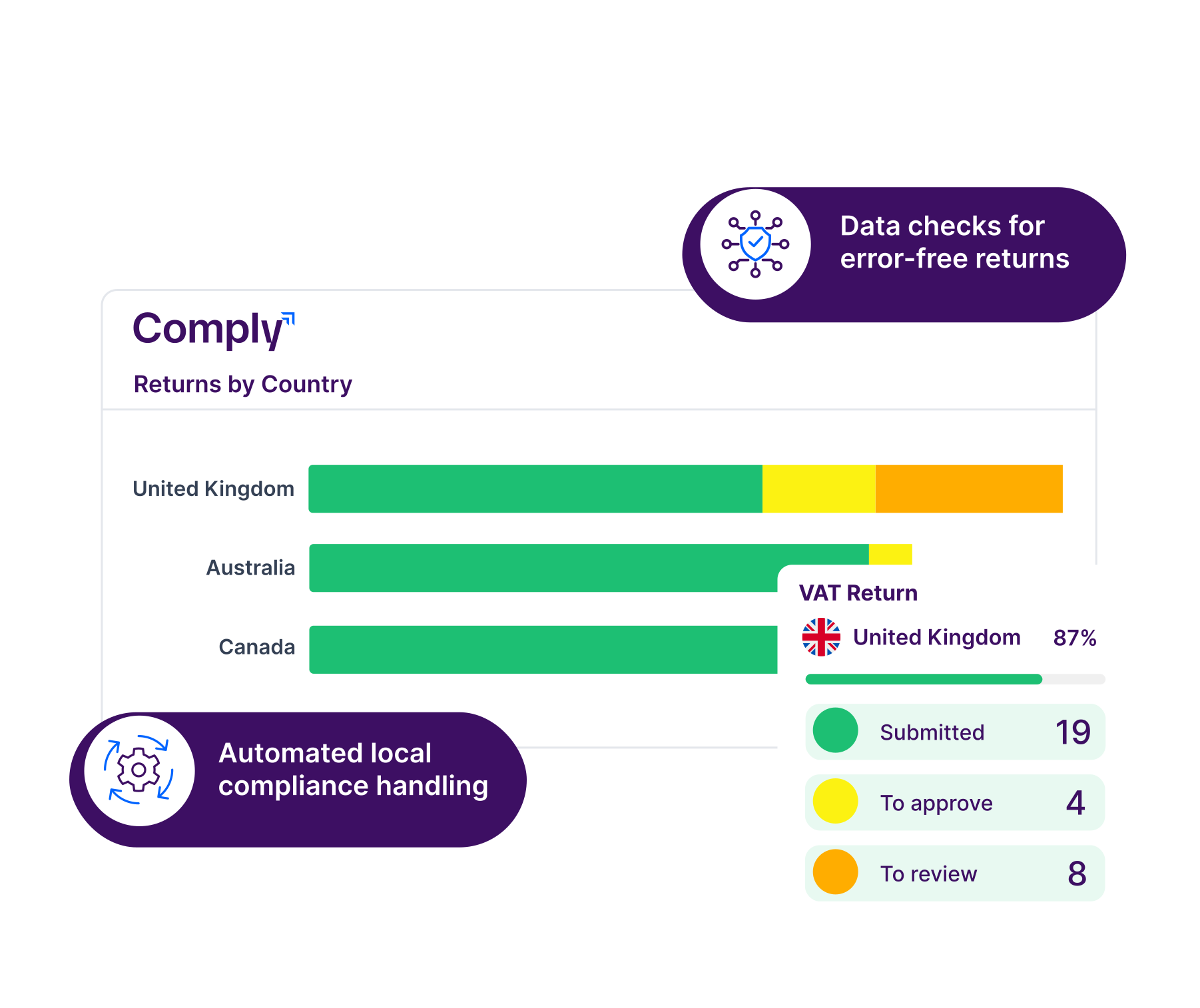
Our VAT compliance solution, Comply helps companies manage their complex, country-specific tax requirements including Italy’s Imposta sul valore aggiunto (IVA) obligations.
Using AI and machine learning, our technology puts your VAT data through over 300 automated VAT rules, checking for errors, and preparing VAT returns for approval and submission. Comply provides a full audit trail for the Italian Tax Authorities.
When does VAT liability apply?
VAT liability in Italy applies to the following transactions:
- Supply of goods and services carried out in Italy by a taxable person acting in the course of business, artistic or professional activity
- The importation of goods into Italy by any person
- Intra-Community acquisitions of goods in Italy by taxable persons
In certain cases, such as supplies made by non-resident businesses to Italian VAT-registered customers, the reverse charge mechanism may apply, meaning the VAT liability is shifted to the recipient.

eInvoicing requirements
Italy operates a mandatory eInvoicing system.
Since 1 January 2019, eInvoicing has been required for domestic transactions between taxable persons (B2B) and for supplies to consumers (B2C). Invoices must be issued and transmitted through the Italian exchange system (Sistema di Interscambio – SDI).
Scope:
- Requires structured electronic invoices in a prescribed format
- Applies to domestic B2B transactions
- Applies to domestic B2C transactions
Non-established businesses
Non-established businesses that are VAT-registered in Italy are generally not subject to the full domestic eInvoicing obligation. However, they may still need to comply with certain reporting requirements depending on the nature of their transactions.
Italy remains one of the most advanced eInvoicing regimes in the EU, with real-time invoice clearance via the SDI platform.
VAT return filing and deadlines
In Italy, VAT compliance involves periodic VAT settlements (monthly or quarterly) and an annual VAT return.
Monthly VAT settlements apply to businesses who annual turnover exceeds
- €400,000 for services
- €700,000 for supplies of goods
Quarterly VAT settlements apply to businesses below these thresholds.
All VAT-registered businesses must submit an annual VAT return (Dichiarazione IVA), including:
- Businesses with no taxable transactions during the period
- Non-resident taxpayers registered for VAT in Italy
- Fixed establishments of non-resident entitie
Filing and deadlines:
- Monthly VAT settlements: payable by the 16th day of the following month
- Quarterly VAT settlements: payable by the 16th day of the second month following each quarter
- Annual VAT return: must be submitted between 1 February and 2 May of the following year
VAT penalties
Failure to comply with VAT obligations in Italy may result in significant penalties.
Late or non-submission of VAT return:
- Failure to submit the annual VAT return may result in a penalty equal to 120% of the VAT due, with a minimum penalty of €250
Late or missed VAT payments
- Failure to pay VAT on time may result in a penalty equal to 25% of the unpaid VAT
- Reduced penalties may apply where payment is made within shorter timeframes (e.g. within 90 days or 15 days)
Additional penalties may apply for incorrect invoicing, reporting errors, or failure to comply with other VAT obligations.
Fiscal representatives
EU businesses
EU-established businesses are not required to appoint a fiscal representative in Italy. They may register for VAT directly with the Italian tax authorities. However, businesses may choose to appoint a local VAT agent for administrative and compliance purposes (e.g. language support, filings and local requirements)
Non-EU businesses
Non-EU businesses are generally required to appoint a fiscal representative in Italy in order to comply with VAT obligations. In certain cases, direct VAT registration may be possible, depending on applicable regulations and reciprocity agreements.
In practice, appointing a fiscal representative is the most common approach for non-EU businesses operating in Italy.
VIES declarations
VIES (VAT Information Exchange System) declarations, also known as EC Sales Lists or Intrastat reports in Italy, must be submitted by VAT-registered businesses that supply goods or certain services to VAT-registered customers in other EU Member States.
VIES declarations are required for:
- Intra-Community supplies of goods
- Certain cross-border B2B services within the EU
VIES declarations are generally submitted on a monthly or quarterly basis, depending on the volume and value of transactions. They must be submitted electronically by the 25th day of the month following the end of the reporting period.
Intrastat
Registration and submission
Businesses must submit Intrastat reports when the value of movements of goods within the EU exceeds the applicable thresholds.
Intrastat Thresholds 2026:
Intrastat Arrivals
Simplified reporting: €2,000,000
Intrastat Dispatches
Simplified reporting: €1,00,000
Deadlines and frequency
Intrastat declarations in Italy must be submitted on a monthly basis once the relevant thresholds are exceeded.
Declarations must be submitted electronically by the 25th day of the month following the reporting period.
Rise Above the Rest
Maximise your potential with our full suite

VAT compliance solution
Rise above complex indirect tax challenges with Comply, Fintua’s revolutionary platform for global indirect tax compliance.

VAT recovery solution
Recover automates the process of identifying and reclaiming VAT on business expenses, both domestically and internationally, helping you boost your bottom line.

Integrated payments solution
Pay simplifies international payments, reducing complexity and costs while ensuring compliance with local regulations and improving financial visibility.

eInvoicing solution
eInvoice enhances efficiency by digitising your einvoicing process, ensuring compliance across multiple jurisdictions and improving cash flow management.