Ireland VAT guide
The Value Added Tax (VAT) Act in Ireland was introduced on 1 November 1972. The legislation of Irish VAT is currently based on EU VAT directives as the country is a member of the European Union.
The official tax authority in Ireland is the Office of the Revenue Commissioners, established in 1923.
Recent updates:
Menu
What is the VAT rate in Ireland?
23%
Standard rate: 23%
Reduced rate: 13.5%, 9%
13.5% rate applies to a wide range of goods and services, including construction and certain labour-intensive services.
9% rate applies to specific sectors, including hospitality, catering, hairdressing and energy (with certain exceptions).
Zero rate: 0%
Applies to exports and intracommunity supplies
Exempt categories: Activities in public interest, such as healthcare, education, financial and insurance services

VAT registration in Ireland
A business must register for VAT if their turnover exceeds the relevant threshold or if it carries out taxable supplies in Ireland.
Resident businesses
Irish-established businesses must register for VAT when their annual turnover exceeds the following thresholds:
– €80,000 for goods
– €40,000 for services
Non-established businesses
There is generally no VAT registration threshold for non-established businesses.
EU businesses:
EU-established businesses must register for VAT in Ireland if they make taxable supplies in Ireland, unless the reverse charge applies or they use the One Stop Shop (OSS) for eligible cross-border B2C supplies.
Distance sales
An EU-wide €10,000 threshold applies to intra-Community distance sales of goods and specified cross-border telecommunications, broadcasting and electronically supplied services where the supplier is established in only one EU Member State. Once exceeded, VAT is due in the customer’s Member State and may be reported through the OSS or a local registration.
Non-EU businesses
Non-established, non-EU businesses must generally register for VAT in Ireland from the first taxable supply, unless the reverse charge applies. Ireland does not require non-EU businesses to appoint a fiscal representative.
eInvoicing requirements
Ireland does not currently operate a mandatory eInvoicing regime.
Under current rules, eInvoicing for B2B transactions is optional and generally requires agreement between the supplier and the customer, in line with EU VAT rules. There is no mandate requiring eInvoicing for B2C transactions, and paper or PDF invoices remain permitted.
For B2G transactions, public sector bodies in Ireland are required to be able to receive structured electronic invoices in accordance with EU Directive 2014/55/EU.
Future developments
Ireland is preparing to implement mandatory eInvoicing and real-time reporting in line with the EU VAT in the Digital Age (ViDA) initiative, with a phased rollout:
- From November 2028: Mandatory eInvoicing for domestic B2B transactions by large VAT-registered businesses. All businesses must be able to receive structured eInvoices
- From November 2029: Extension to VAT-registered businesses engaged in intra-EU B2B transactions
- From July 2030: Full implementation of EU-wide eInvoicing and digital reporting requirements for cross-border B2B transactions

VAT return filing and deadlines
VAT registered businesses in Ireland must file VAT returns at a frequency determined by their VAT liability.
- Bi-monthly: Is the standard for most businesses
- Monthly: May apply where authorised by Revenue, for example where a business is in a regular VAT repayment position
- Four-monthly: May apply where annual VAT liability is between €3,001 and €14,400
- Six-monthly: May be permitted for businesses with low annual VAT liability of €3,000 or less
Deadlines:
- the standard deadline for filing and payment is the 19th of the month following the end of the taxable period
- Where returns are submitted electronically via Revenue Online Service (ROS), the deadline is extended to the 23rd day of the month following the taxable period.
- If a deadline falls on a weekend or public holiday, it generally moves to the next working day.
Comply – Global VAT compliance
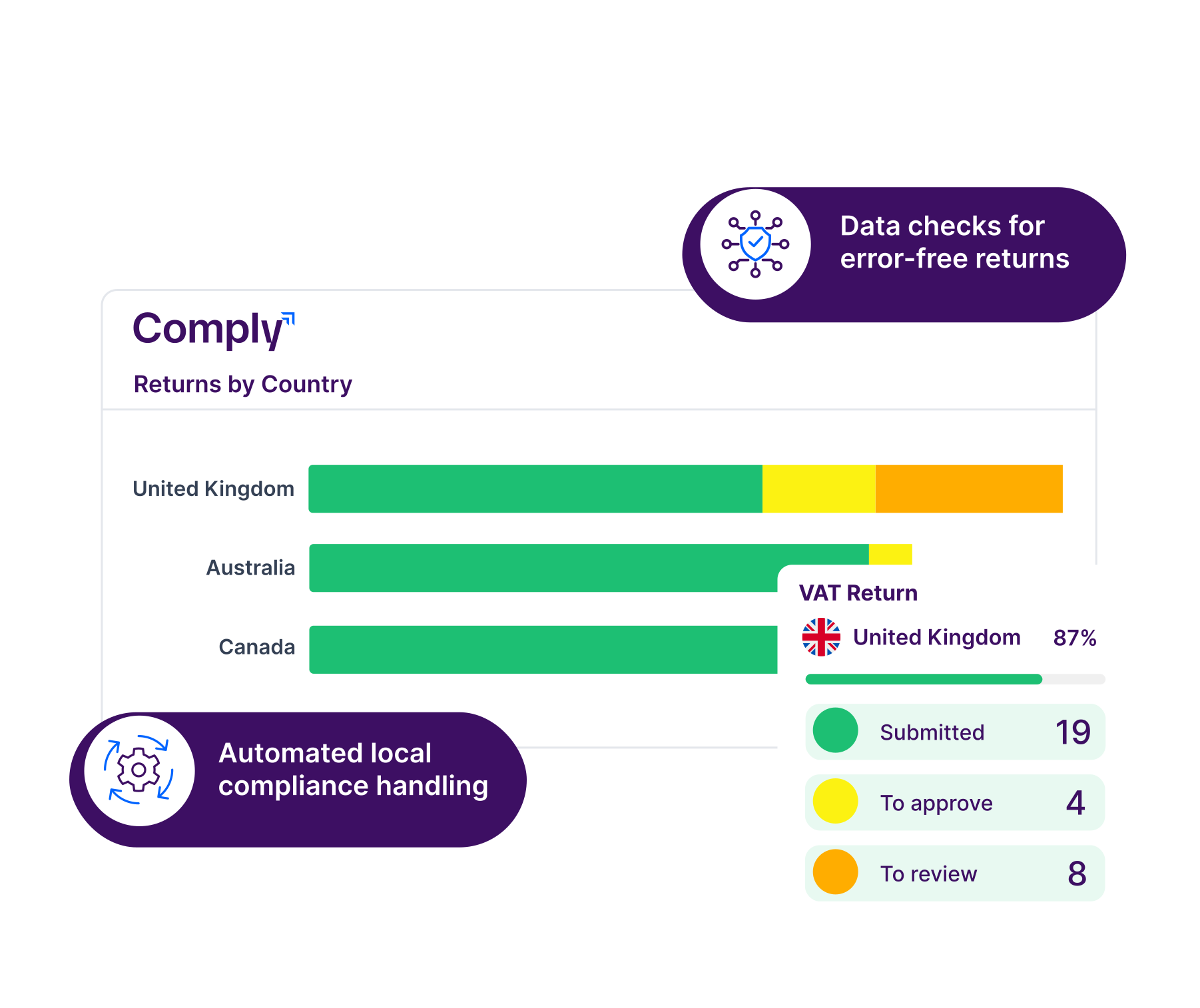
Our VAT compliance solution, Comply helps companies manage their complex, country-specific tax requirements including Ireland’s VAT obligations.
Using AI and machine learning, our technology puts your VAT data through over 300 automated VAT rules, checking for errors, and preparing VAT returns for approval and submission. Comply provides a full audit trail for the Irish Tax Authorities.
VAT penalties
A fixed penalty of €4,000 may be imposed for non-submission or late submission of a VAT return.
Late payment of VAT does not generally result in a fixed penalty. Instead, interest is charged on overdue amounts (approximately 0.0274% per day, or around 10% per annum).
Fiscal representatives
Fiscal representatives are not required in Ireland. Non-established businesses may register and account for VAT directly with the Revenue Commissioners.
VIES declarations
VIES (VAT Information Exchange System) declarations must be submitted by VAT-registered businesses that supply goods or services to VAT-registered customers in other EU Member States.
VIES filing frequency is monthly or quarterly, depending on the nature and value or the supplies. They must be submitted by the 23rd day of the month following the end of the relevant reporting period.
Intrastat
Registration and submission
Businesses must submit Intrastat reports when movements of goods within the EU exceed specified thresholds.
Intrastat Thresholds
Intrastat Arrivals
- Simplified reporting: €750,000
Intrastat Dispatches
- Simplified reporting: €750,000
Deadlines and frequency
Intrastat declarations in Ireland must be submitted monthly once the relevant thresholds are exceeded.
The deadline for submission is the 23rd day of the month following the reporting period.
Rise Above the Rest
Maximise your potential with our full suite

VAT compliance solution
Rise above complex indirect tax challenges with Comply, Fintua’s revolutionary platform for global indirect tax compliance.

VAT recovery solution
Recover automates the process of identifying and reclaiming VAT on business expenses, both domestically and internationally, helping you boost your bottom line.

Integrated payments solution
Pay simplifies international payments, reducing complexity and costs while ensuring compliance with local regulations and improving financial visibility.

eInvoicing solution
eInvoice enhances efficiency by digitising your einvoicing process, ensuring compliance across multiple jurisdictions and improving cash flow management.